
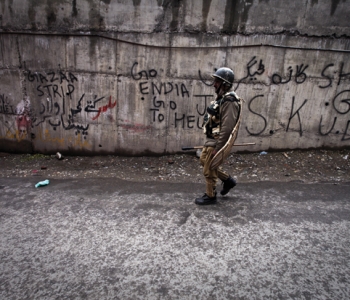

Many CRPF personnel have expressed their displeasure at being forced to patrol the streets with just lathis. Photo: Abid Bhat
As the spring wind got stronger, the hail of stones came to a halt. The CRPFpersonnel manning the mobile outpost sat for a quick lunch on the Azad Gunj Bridge in Baramulla, located 75 km from Srinagar in the north, one of the most hostile regions in Jammu & Kashmir for these soldiers.
As they finished eating, one soldier from Amravati in Maharashtra cheered them up by singing Bollywood tunes. Another jawan, who was until now humming along, started fiddling with his cell phone to gaze at his wife’s photograph. Clad in riot gear, the jawans rested their AK-47s, pellet guns, shields and sticks against the downed shutters. As they gossiped about their injured colleagues, it was evident that they were trying to understand the outrage.
“It’s been 17 days now. We are eating, sleeping and peeing here,” says a jawan. “Even five-year-olds hurl rocks at us. Afzal is gone, but why are these protesters chanting pro-azadi and pro-Pakistan slogans?”
These soldiers are among the 60,000 CRPF men deployed in the Valley, besides the additional 10 companies brought in, to control the protesters, who are angry overAfzal Guru’s secretive hanging and burial. Guru was was hanged on 9 February for his role in the 2001 Parliament attack.
It’s 10 March and Baramulla continues to reel under curfews. The first was imposed after Guru’s hanging and then the death of Tahir Rasool Sofi, 27, who was allegedly killed by members of 46 Rashtriya Rifles on 6 March. An hour-long drive to Baramulla from Srinagar brings back memories of 2010. Baramulla resembles a ghost town. The only signs of life are stray dogs, ambulances, police jeeps, army convoys and soldiers who have spent 15-hour workdays for almost a month on the streets facing stone-pelters and then loneliness when the angry youth take a break.
The last time Kashmir looked anything like this was the summer of 2010 (Listen to the Stones by Shoma Chaudhury, 23 October 2010). That year, more than 120 people, mostly youth, were shot dead and thousands were injured in the pro-azadi protests. Finally, it took a delegation of MPs and Hurriyat leader Syed Ali Shah Geelani to bail out New Delhi from the quagmire.
The UPA government had thought that a secret hanging wouldn’t trigger ferocious protests although J&K Chief Minister Omar Abdullah had warned otherwise. However, Omar was proved right. Guru’s hanging has offered a fresh impetus to both pro-azadi cries and separatist politics.
AFTER A shaky calm of two years, the uprising is gathering steam once again. At Azad Gunj Bridge, pitched battles between stone-pelters and security forces have become the norm. On the other side of the bridge, things look gloomy. The smell of burnt tyres and four-day-old fumes from teargas shells and pepper gas canisters are still in the air. Holes made by pellet guns, which send 600 high-velocity iron balls at one go, are visible on the tarpaulin covers of streetside stalls and the bodies of young boys whose images were circulated on social networking sites last week. One of the images shows a boy’s back dotted with more than a dozen pellets, blood oozing from the dark red circles and a nurse removing the iron balls with a small pincer. The image doesn’t show the boy’s face, fearing detention in the nocturnal raids by the police to nab the stone-pelters.
On the rooftop of an elegant but decaying house in Kakerhama, 11-year-old Imran* coils the long thread between his thumb and little finger. For one hour, he is an enthusiastic kite flier. The next hour, he is out on the streets brandishing an ageold weapon: the stone. “This is a powerful weapon of the weak,” he says.
Imran is joined by two other boys — Ali*, a school-goer, and Atif*, an orphan scrap collector. Armed with slingshots, they form a formidable trio and are known for sneaking closer to the soldiers before targeting them. Asked why they are pelting stones, the reply is prompt: “For freedom.”
Between our conversation and chaos, Imran tosses a flat pebble towards the other end of the Azad Gunj Bridge, where a posse of police and CRPF personnel stand guard behind the loops of concertina wire. Seconds later, a stone returns, whizzing past the kids at more than 60 km an hour.
“Sometimes, their response is different,” says Imran, showing his left leg still wrapped in a bandage above the ankle. A few days ago, a bullet scraped past his body. The bullet that later smacked a stone behind him is now a war souvenir, which he proudly brandishes to other children.
These kids are typical stone-pelters in this town of winding lanes, cone-roofed heritage houses and old brick shops that offer the perfect medieval charm. This is also where India has further shrunk from the collective conscience of its inhabitants. Talk to anyone in these streets, people say that Guru’s hanging will cost Delhi dear

Images of youth injured by pellet guns have gone viral in the Valley. Photo: Abid Bhat
“That’s why unlike the past, we will not allow this movement to die down. We have the people with us,” says an executive member of Mutahida Majlis-e- Mashawarat, a non-mainstream political group, which has taken charge of the protests. Members of this joint platform of various separatist organisations are in hiding and have issued a protest calendar in support of the demand for the return of the mortal remains of Guru and Maqbool Bhat, a pro-azadi JKLF leader, who met a similar fate on 11 February 1984.
Interestingly, the jawans on the ground witnessing the ferocity with which the stone-pelters are attacking them are now questioning the role of politicians, who, they say, are deliberately avoiding a political debate on Kashmir. “I have been observing J&K since 1987. We have pumped in enormous money and huge number of armed personnel, but the anger against India has only gone up. And those who face this ire are my jawans,” says a senior CRPF officer posted in Srinagar. “As long as a political solution eludes Kashmir, the anger against India will keep mounting.”
What these soldiers are facing on the streets is a new breed of stone-pelters who are often seen opening the buttons of their shirts and inviting troops to fire at them. “It’s difficult to control our soldiers who are also young and bubbling with energy,” says another CRPF officer. “The stone-pelters are insensitive to death and they can prove dangerous if they get any weapons.”
To understand what it feels like to man the angry streets of Srinagar, TEHELKA took a ride inside a white jeep along with two CRPF personnel. They hail from Manipur and have been posted in Kashmir since 2010. The ride starts from the restive Batamaloo and ends at HMT junction, where their colleagues are being treated for severe head and limb injuries. During our ride, no stone is hurled although we passed through two “sensitive” areas.
“The world looks small from this hole,” the soldiers joke. Both of them come from violence-prone Manipur and have found overwhelming political dissent inKashmir. “I have never seen such intense stone-pelting in my life. I don’t understand what Kashmiris want?” says a jawan, and after a pause, adds, “Stone-pelters are more dangerous than militants who fire at you. In the latter case, you can at least release your anxiety and fire back in retaliation.”
The conversation stops when the jeep comes to a halt outside the unit hospital in north Srinagar, where ASI Jai Singh of the 44 Battalion is battling for his life.
Singh’s fourth posting in Kashmir turned ugly on the evening of 4 March. In Saraf Kadal locality, some youth managed to push back a group of CRPF men. While retreating, Singh fell down. Before he could get up, the angry mob seized him. “The boys removed my helmet and chin guard. They pelted my head with stones until I passed out,” he says.
The stone-pelters left him badly injured in the street until a local resident took him to his house and called the police.
“ASI Singh could have fired at the protesters but he showed utmost restraint,” says CRPF IGP VS Yadav. “Like Singh, many of my boys have been badly injured. Yet we remain under-appreciated.”
Since Guru’s hanging, 350 CRPF and 300 policemen have been injured and more than 250 vehicles damaged in the stone pelting. Nearly 340 boys have been arrested in the past one month; 96 of them are still in custody while the rest are out on bail. Officially, 58 injured youth have been admitted to various hospitals, but unofficial estimates say that more than 600 youth have sustained injuries. Many don’t come to hospitals for the fear of being arrested.
Adding to the CRPF’s woes is the rift with the local police. The police has been accusing CRPF of violating standard operating procedures. Videos showing CRPFmen kicking in doors and breaking windows have gone viral. Such videos have fuelled hatred against the force. In fact, the police shot a letter to the CRPF asking them not to carry firearms at protest sites. There have been nine civilian deathssince Guru’s hanging and FIRs have been registered against the CRPF in four cases.
But CRPF officers see such moves as a “well-planned tirade” against the paramilitary force. “We don’t subscribe to the political rhetoric on disarming us at protest sites,” says a senior officer. “Only Central laws are applicable to us.”
The CRPF has also come under fire for using pellet guns, which were blamed for taking many lives in 2010.
Through the pigeonhole of an outpost in Srinagar, CRPF trooper Ramchand is trying to understand the anger raging across Kashmir after Guru’s hanging. “I never managed to appreciate the beauty of the Valley,” he says. “I always seeKashmir through these holes. And what I see today is just anger and fury.”
For Ramchand, the degree of rage has only increased in the past six years of his duty across Kashmir. His appreciation of anger isn’t rare among the thousands of soldiers who are now questioning their role in this conflict.