Baba Umar
Currently what Kashmir is watching are three parallel realities. The first bids for the India’s ‘surgical strike’ inside Pakistan-administered Kashmir. The other competing reality suggests it was a ‘cross fire’. After all Pakistanis were on toes across the de facto perimeter following deadly Uri attack and quick revenge calls by New Delhi and handle bar-moustached soldiers. This reality dwarfs the claim of five-directional border incursions by Indian soldiers without getting detected. Credible entity – the UN and the reportage of The Washington Post, BBC and The New York Times someway cast doubts on the first reality as well. New Delhi may, however, want to release some evidences to back its claims.
The third, which is important – at least to Kashmiris content with the overall global reportage on 2016 Kashmir uprising – is that the Uri attacks and the subsequent bravado of both armies have pulled the Kashmir story out of the front pages. It’s here New Delhi must be feeling slightly comforted. Pictures of pellet-hit faces on the front page of The New York Times and elsewhere were quite an international embarrassment.
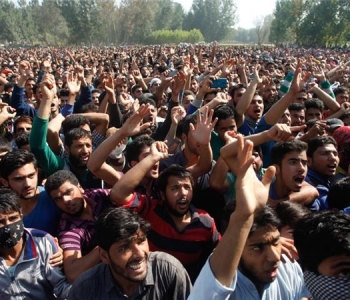
With the conflicts raging in Syria and Yemen, the American media’s obsession with Donald Trump and news of UK’s Brexit moves, it was extraordinary to find yet again stories in the global press of killings and pellet victims, stone hurling against New Delhi’s rule in the Himalayan region, curbs on newspapers and Internet, and over-militarisation of Independence-demanding Kashmir. The mood reminiscent of 90s and the previous uprisings of 2008 and 2010 forced a rethink among Indian human rights activists and doves.
The Uri attack and the ‘surgical strikes’ have sidetracked this coverage. It was also after a long time that the Kashmir uprising moved the otherwise inert Pakistan, which is seen forcefully promoting Kashmir’s right of self-determination at all international forums. Twice in 2008 and 2010, when Kashmiris launched massive anti-New Delhi protests, Islamabad was looking for means to soothe itself. Tehreek-e-Taliban fighters had penetrated deeper into Pakistan. Islamabad’s Kashmir policy was in tatters. It was desperately looking for a breathing space. As one Kashmir editor friend mocked, “Suicide bombing is fast becoming a national game in a country where cricket is oxygen.” Adding to the national bewilderment, narratives and counter-narratives, Pakistani elites awed by neighbouring India’s growth story and movies were chiding the army led by dormant Ashfaq Parvez Kayani.
The operation of Zarb-e-Azb in June 2014, however, took the battle into the mountainous fiefdoms of the TTP rebels who were either killed or forced into Afghanistan. It changed the dynamics of a deadly insurgency inside the country. The war immediately reversed TTPs gains. Pakistan also turned the heat against Muttahida Qaumi Movement (MQM) to re-establish its writ in the Sind province whose leader Altaf Hussain spoke from self-imposed exile against Pakistan in August and earlier.
The success of Zarb-e-Azb – billed to be one of the world’s largest counter-insurgency operation – was also important to secure the Chinese investment of $46bn that links historic Chinese city of Kashgar with southern energy-rich Gawadar port. Called China Pakistan Economic Corridor (CPEC), this investment is planned to shoot up to $150bn. “CPEC will blaze a whole new trail,” say Chinese President Xi Jinping and Prime Minister Nawaz Sharif. With the economic recovery and stalemate in Afghanistan despite rival India securing some foothold, Pakistan tasted quick feats. It’s in this setting that Kashmir’s homegrown uprising has taken place following Burhan Wani’s killing. It’s perhaps for the first time that Pakistan has named and hailed a Kashmiri rebel leader at the UN.
PM Nawaz Sharief said Wani is a “symbol of the Kashmiri Intifada, a popular and peaceful freedom movement…” before the world leaders at the UN general assembly. Wani’s stature thus has grown more than iconic Kashmiri rebels Maqbool Bhat or Ishfaq Majeed who led some of the first battles in Kashmir. In fact there is a realisation within the Kashmir’s resistance leadership that Pakistan has been promoting the Kashmir cause from the pulpit of power this time around.
The violence against the people hasn’t, however, died down. As I write this, social media is humming with the news of mass arrests and violent protests in Kashmir where 90 people have been shot dead so far and thousands injured. There are allegations that volunteers inside the hospitals are being detained. A Sufi cleric, Moulana Sarjan Barkati, famous among locals as Azadi Chacha (or Freedom Uncle), who rose to prominence for introducing lyrical pro-Kashmir slogans, was recently arrested and charged under Public Safety Act (PSA) called “lawless” by rights group Amnesty International. A noted human rights defender Khurram Parvez is serving jail under the same law. Parvez was arrested from his home last month.
On social media – that has become an alternate voice of Kashmiris – new videos and photos show raiding soldiers burning down or destroying this year’s harvest – rice and apple both – spine of Kashmir. Now this is evocative of the notorious “scorched earth” policy (under which crops were burnt during harvest spell and granaries emptied) followed by the colonial French troops during Algeria’s occupation.
On September 28, Kashmir Reader reported that Indian forces have set ablaze rice crops in the villages of Budran, Aadina, Kanihama and Mazhama in central Kashmir. The Facebook feed of another influential paper Rising Kashmir shows pictures of destruction in the rice fields of another defiant village in south Kashmir. Greater Kashmir too has been reporting the raid on harvest.
This isn’t a new normal though. I observed the trend in January 2013 when the government forces overran an apple orchard in northern town of Sopore uprooting over a hundred and fifty fully-grown trees after an overnight gunfight left five rebels dead. The collective punishment was meant to discourage the locals from hosting rebel fighters.
Kashmir Reader, one of the fiercely independent papers in Kashmir focusing on stories often ignored by nationalist media, stands muzzled now. The gag order says the paper must shut operations because it can “incite violence and disturb peace.” One wonders what incites violence? Burning down of crops or reporting it!
Back in the mountains, Pakistan doesn’t want to acknowledge the so-called ‘surgical strikes’. Because then Islamabad will have to respond to it as well. Indian forces sense this. That’s why villages in India’s Punjab and elsewhere in Kashmir contagious to Pakistani borders have been emptied for a possible wider escalation. With its army stretched along the Durand Line, Pakistan has smartly chosen to deny India the legitimacy of ‘surgical strikes’ which New Delhi desperately wants to market to its people and also to the world.
This is where we are. The Kashmir story has been pushed aside by the Pakistan and India flare up. The story of over two months uprising inside volatile Kashmir and how the government forces are scuttling it by all means stands distracted.
Originally published in Greater Kashmir.
