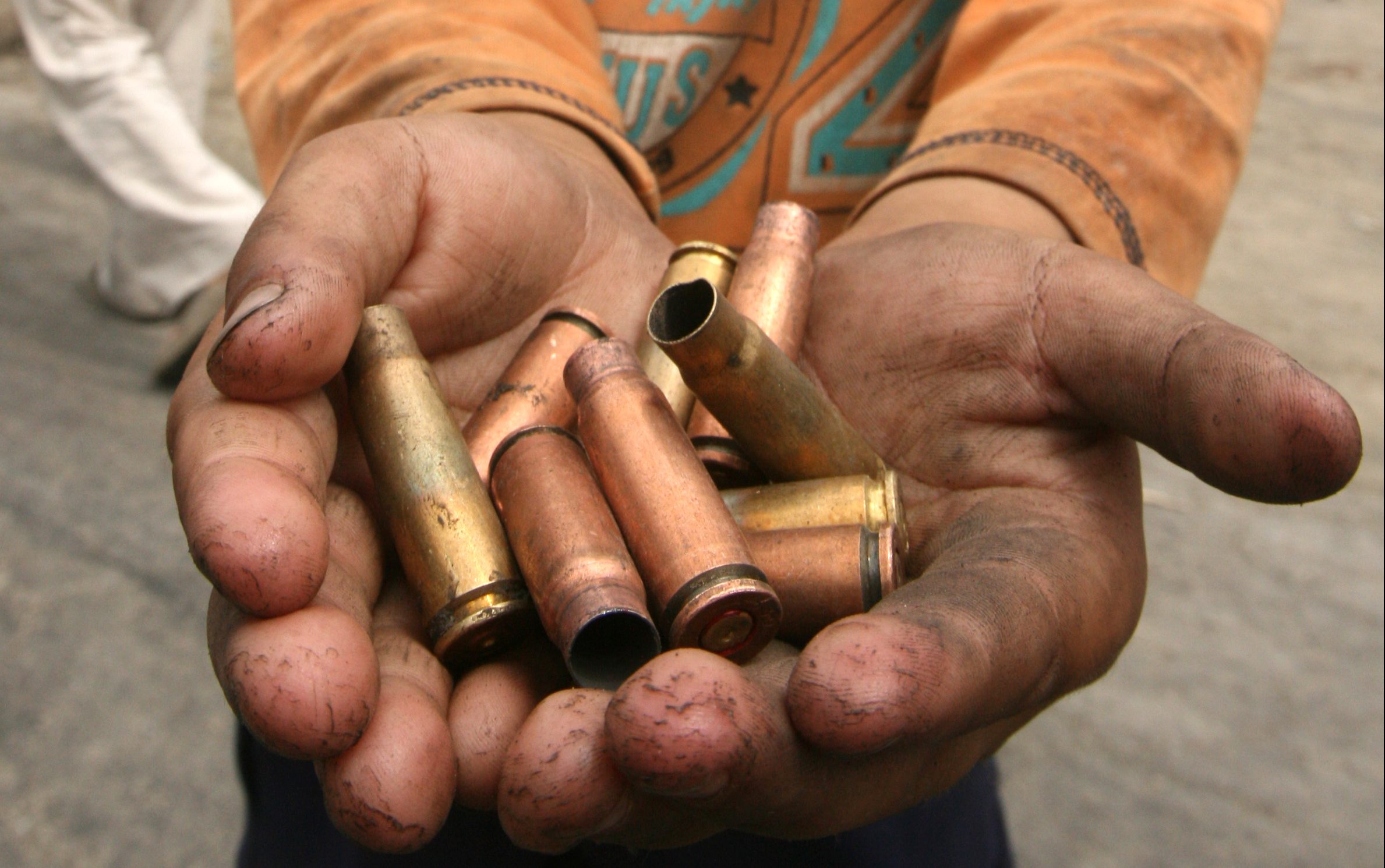
Hit by bullets in the abdomen, hours of interrupted ambulance drive to the hospital, couple of small and big perforations, three-hour-long surgeries and now over two weeks in the hospital, they are ready to throw caution to the winds and get back on the streets to chase their dreams of freedom.
“I’ve weathered the worst. Nothing is going to scare me now,” says 17-year-old Owais War proudly.
In the afternoon of August 2, this Class X student was rushed to Srinagar’s SMHS hospital after police and paramilitary CRPF allegedly shot dead his uncle Khursheed Ahmad War, a driver by profession, and pumped a bullet in Owais’ abdomen, barely half-a-km from their house in Shumnag in North Kashmir’s Kupwara district.
The duo had gone to attend a marriage ceremony in a nearby village, not knowing a cavalcade of troops and police were cruising on the road and getting closer.
“When we saw the vehicles approaching, we didn’t make any movement. We stood on the roadside,” Owais, on Bed no 16 at Ward 16, recalls.
They were then shot at. Owais’ uncle died on the spot while Owais, who tried to save his uncle, was fired next.
Doctors who operated upon the boy consider him lucky. They say the incident occurred at around 2:45 pm and the patient was brought to the hospital at 7 in the evening.
“He is alive because he has met the golden hour,” says a senior surgeon who operated upon the boy.
In trauma care, the doctor informs, the golden hour is the time between the incident and the time the injured is on the operation table which, if met, offers the best chances for survival.
During the surgery doctors removed the victim’s colon partially; however, the strange feeling of a hot bullet entering his soft skin has solidified the boy’s take on Kashmir conflict and hardened his stance on protests and stone-pelting.
“Kashmir was a separate entity before 1947. The UN became the arbitrator of the conflict that ensued later. If India denies this, we have every right to protest,” says Owais, whose father Nissar War is a spice trader.
“And if they shower bullets, what option do we have. We can pelt them with stones only,” he says, adding his father will allow him to join protests.
This year Owais watched his favorite World Cup football team Argentina play in South Africa but was saddened to see them lose in semis, with Paul Octopus choosing Spain for the title. “I do wish to see Paul Octopus choosing Kashmir as the winner in this game of conflict,” he says.
Aware of the lingering unrest here, Owais says he joined peaceful protests several times in his village, but once he nurses back to health, he might hurl rocks on troops and police “if provoked”.
“I may die in their firing. But wasn’t I close to death last time itself,” he asks.
Like Owais, there is another youth getting “baptised” in the fire on the same day. For him too, bullets are no deterrent to protesting youth.
The 21-year-old Hilal Ahmad, son of a labourer Abdul Majeed, was hit by a bullet in the abdomen in South Kashmir’s Bijbehara when police and paramilitary CRPF intercepted hundreds of peaceful protesters coming from Jablipora village to the main road.
Hilal, who is pursuing graduation in science, participated in the August 2 procession early morning that was on way to offer funeral prayers of a youth killed in a neighbouring village.
“Police teargassed the mourners first…And as we retreated, they charged in along with CRPF personnel and barged in some houses. They were on a rampage. They broke window panes and doors and beat up many people with bamboo sticks and gun butts,” he recalls.
Later at around 9 am, Hilal heard Masjid loudspeakers announcing another phase of peaceful protests. “Some 300-400 people gathered this time,” he says.
However, as soon as the procession drew closer, troops and police again halted the gathering with teargas shells. Those leading the crowd retaliated with stones.
“Then they fired at us,” Hilal says “and the result was this”. He shows a 2×2 cm-wide bullet wound on the abdomen and a mark left by a bullet that brushed his right arm.
Hilal felt the heat of the bullet and blood continued to gush out but he ran back into the retreating crowd knowing fully that falling down in front of the troops would mean certain death, with no immediate hospitalization. “I ran back towards the crowd till I hit the ground,” he narrates.
Hilal was later ferried in a Maruti car by his close friend Rizwan along with Hilal’s mother Jana Begum towards the town hospital. Heavily armed troops throughout the road and countless razor wire barricades were, however, the key hurdles.
Hilal could have missed the ‘Golden Hour’ but his friends managed to get him to SMHS hospital in Srinagar before two in the afternoon.
Hilal, according to doctors, was operated for small and big perforations in the intestines and some 2 pints of blood (app 1 litre) were injected to compensate for the blood loss. “If he were a kid or an old man, he would have died on the way,” said a senior doctor, refusing to be named.
On the thirteenth day of his stay in the hospital, Hilal says he hadn’t thought he will be shot for hurling stones. “I tossed only one rock and I was shot for it. They could have allowed us to move peacefully. But they aimed our bodies,” he says.
Like Owais, the incident has strengthened Hilal’s battle for freedom. He says he will restart joining protests and shout slogans against India and troops. “But I’ll not hurl stones. I had almost killed myself,” Hilal says. He is however quick to add that many of his colleagues may not continue with peaceful protests if they are cane-charged, teargassed or fired upon.
During the stay in the hospital, Hilal penned down a 34-verse poem ‘All The Pain’ that paints a vivid picture of how it is like to protest in Kashmir. The poem describes the journey of a young protester until the victory is claimed.
On being insisted, Hilal reads out a couple of stanzas:
Facing the weapon bare hands
Who’ll listen?
Facing the bullet, oozing the blood
Who’ll listen? …
And the poem ends with,
Victory is ours
Hope we get it.
The past two months of protests by youths and firing by heavily armed troops have left 58, mostly teenagers, dead and thousands injured, many of them critically.
And experts say that things are looking depressing than ever before.
“See, this is unresolved anger against the injustice. Till the sense of justice is not perceived by these kids, the anger will either express in one form or other; or get repressed momentarily to surface again,” infers a psychiatrist.
He believes it is always good for the victims to share or document their anger and frustration without internalizing it.
“Yes if it is in a safe and secure internal and external environment, it is catharsis and therapeutic,” he says.
Expert on disaster psychiatry, Dr Mushtaq A Margoob, warns of harms deliberately caused by others that can lead to shifts in societal conventions and processes.
“This may include an increased sense of rage and entitlement to revenge when mourning loss or reversal of feelings of helplessness and humiliation,” he said.
In an interview to TOI recently, Dr Margoob said the developments of defying troops could also be a manifestation of the ever-increasing indescribable levels of frustration and anger among this ‘trauma generation’, who have hardly seen a minute of complete peace or tranquility in their lives.
In fact, separatists have already expressed their desire “not to let the popular rage get dissipated”.
“Youth of the valley don’t want temporary peace but a permanent solution. They have already taken the baton of freedom struggle and no amount of repression or army can control it now,” said Hurriyat (M) Chairman and the Chief cleric at Srinagar’s largest mosque in a recent interview.
Kashmiris, he said, are “willing to confront death”.
Masrat Alam, who is rising as the new face of rage on the streets, says the struggle has entered a “decisive phase. And in this struggle, every house has become our office and every individual our worker and colleague”.
http://www.risingkashmir.com/news/are-bullets-baptizing-kashmir-youth-344.aspx
