Forest officials are losing the battle against a well-oiled timber mafia that is stripping the Kashmir Valley of its green cover, reports Baba Umar
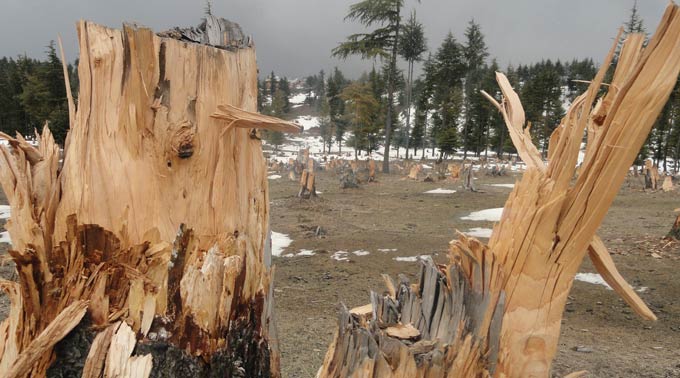
A DIRT track snakes through a picturesque hill that is home to white poplar and willow trees. Camouflaged army trucks ferry gun-toting soldiers. Curious children with apple cheeks peek at passersby from mud huts: The bumpy 8 km ride from Shopian town to Karewa Manloo offers a typical slice of life in the hills of Kashmir. However, things aren’t as they seem as one-time verdant slopes of tall coniferous trees have literally turned into a massive graveyard.
“A great game is underway between government officials and timber smugglers,” says Mohammad Shafi, a villager from Karewa Manloo. “In the day, the slopes are guarded by Forest Department personnel, but in the night, it’s the smugglers whose writ runs large.”
Despite the Supreme Court ban, lakhs of coniferous trees in this area have been cut down, stolen and smuggled over the past few years. What are left behind are branches and stumps. The area seems like an abandoned cemetery with each stump looking like a weather-beaten tombstone.
Smugglers have plundered the slopes of Karewa Manloo, which fall in the southern part of the mighty Pir Panjal mountain range. The story is no different in central Kashmir’s Budgam district, which forms the core of the Pir Panjal, where smugglers have shaved off entire slopes of Drang, Socuchal Pathri, Lasipora, Kachipora, Chil, Brass, Zogov, Kheran and Rigzabal.
“The situation in Sitharan forests (located 40 km from Budgam) was so bad that last year we had to lay siege to the area with the help of the police and paramilitary forces to battle the timber smugglers,” says Ghulam Hassan Bhat, Divisional Forest Officer of the Pir Panjal range.
Bhat claims that 324 FIRs have been filed against 1,038 accused in the past two years. But even the Public Safety Act, which has been filed against 27 smugglers, or seizing 260 ponies, haven’t deterred the smugglers operating across the 480 sq km of forests.

In Budgam, thousands of cases against smugglers are pending and the conviction rate is dismal. Almost 19,000 ponies and hundreds of vehicles have been seized from smugglers in the past 20 years, say officials. The vehicles are rusting away at the Forest Department offices, while the ponies are often retrieved by smugglers through brokers in government auctions.
Timber smuggling is lucrative because there is a big gap between supply and demand in the state. According to one estimate, the annual demand for wood in Jammu & Kashmir is around 1 crore cubic feet. The market rate of Deodar is Rs 3,500 per cubic feet while other conifer varieties such as Kail and Budul are sold for Rs 1,900 and Rs 900 per cubic feet respectively.
‘THREE GUARDS ARMED WITH STICKS LOOK AFTER 6 KM OF FORESTS AND OUR JOB IS TO RESIST SMUGGLERS WHO ARE ARMED WITH AXES AND IRON RODS’
IQBAL AHMAD FOREST GUARD
While the Forest Department is expected to allot 80 lakh cubic feet of dried and diseased timber from forests to locals every year, the availability of such wood is very modest, say officials. For example, in Budgam district, the department is able to supply only 1 lakh cubic feet against the demand of 12 lakh cubic feet every year.
But some experts believe that the scarcity has been “artificially created” by the department, leading to massive smuggling. “This scarcity is man-made,” says Shakeel Qalander of the Federation Chambers of Industries Kashmir (FCIK), an apex business body. “We have more availability than demand. The Forest Department and its different wings aren’t extracting damaged timber, which triggers smuggling.”
“The entire activity takes place in three phases,” explains Ali Mohammad, 65, a woodcutter and a former timber smuggler. “Armed with axes and saws, groups of 50- 60 woodcutters go into the mountains. They chop down trees, remove the bark and forge 6-10 ft long rectangular planks. It takes almost three hours for the woodcutters to work on an adult tree. The next group ferries the timber planks (weighing approximately 100 kg) on ponies and take it to the villages. The third group is responsible for transporting it to Srinagar and other major towns where it reaches saw mills and ends up as furniture in posh houses.”
MOHAMMAD CLAIMS to have chopped more than 100 adult pine trees in his five-year stint in Sitharan forests, “for which a woodcutter is paid Rs 500-Rs 1,000 every night”. The peak season is between June and September and in winters. Mohammad and 25 other smugglers had surrendered along with their ponies and tools in 2008. However, 13 of them are back in the illegal business. The rest, including Mohammad, have been employed by the Forest Department as ad hoc ‘contingency forest guards’ or whistleblowers, on a salary of Rs 3,000.
Mohammad says that reformed smugglers face constant death threats. His fear is shared by Forest Department employees and the department has lost 90 men in attacks by the mafia in the past 20 years.
Former smuggler Sonaullah Zargar, 35, used to work as a guard in the forests of Sukhnag range. On 21 June 2011, timber smugglers, allegedly in connivance with Forest Department officials, attacked the father of four with an iron rod and strangled him to death.
“Sonaullah had alerted forest officials about a cache of illegal timber kept hidden in the forests,” says his brother Abdul Majid, a resident of Basant Wuder, located 56 km east of Srinagar. “On his way back home, some forest officials and timber smugglers silenced him forever.”
Four smugglers and Block Forest Officer Abdul Gani War were arrested in connection with Zargar’s murder, which is an alarming reminder of the brutality that the timber mafia is capable of unleashing.

But similar murders have gone unnoticed. For example, Abdul Rahman Ganaie, 35, a forest guard, was axed to death in 1997. He left behind a wife, six kids and old parents. The Forest Department offered his wife, Jana Begum, a Class IV job. “The murderers were never arrested. Instead, ‘justice’ was served when the Forest Department stopped paying my salary after three months,” says Jana, a resident of Sonpah village, located 20 km from Budgam.
In another incident, on 10 June 2004, forest guard Farooq Ahmad Sheikh of Zanigam village lost his life to timber smugglers after having seized 100 ponies and 2,500 cubic feet of timber in a year.
“They labelled my father as anti-resistance and got him killed by militants,” says Sheikh’s son Iqbal Ahmad.
Ahmad, 25, was later given a watchman’s job by the Forest Department. “Mine is a special division at Darkash Tangmarg. We are three guards looking after 6 km of prime forests and our job is to offer ‘stiff resistance’ with sticks to timber smugglers who are often armed with axes and iron rods,” he laughs. “I am willing to pay money to get transferred out of here.”
WHILE FOREST officials plead helplessness in facing the armed timber smugglers, efforts of the Forest Protection Force (FPF), a special unit created by the Forest Department to tackle the smugglers, have fallen apart. The FPF was established in 1997 and the personnel were given arms training to counter the timber smugglers. However, at present, nine FPF personnel are managing the entire Pir Panjal mountain range armed with nothing but lathis.

“What can our men do when they are battling smugglers armed with axes, pistols and sometime even AK-47s?” asks FPF Deputy Director Javaid-ul-Hassan.
Two months ago, Hassan’s team confronted timber smugglers near his office in Budgam. The raiding party managed to arrest nine smugglers and seize eight ponies. The battle left many of his men injured. “But what happened an hour later was horrible,” he recalls. “Almost 100 smugglers armed with axes and sticks attacked our office. They ransacked the office and retrieved their ponies. However, they couldn’t rescue their comrades because we had handed them over to the local police before the raid took place.”
While J&K Forests Minister Mian Altaf has continuously asserted that the timber smuggling mafia won’t be spared, top government officials say that “the jihad against timber smugglers is useless” unless the FPF is armed with guns and the number of forest guards is increased. Now, the ratio is one guard for every 5-6 sq km.
“We are fighting the timber mafia with sticks and whistles. What we actually need is a proper armed force and more men to protect the forests,” says Chief Conservator of Forests (Kashmir) Manzoor Ahmad.
In the state where timber smuggling is often blamed on militants, the army, state-funded renegades or kingpins with support from all of the above, many believe that the situation is spiralling out of control.
“The government should support alternative livelihood programmes because it is mainly a poverty issue,” says Carin Jodha Fischer, a German-American who works on rural tourism initiatives in Kashmir. Fischer, who had tried to reform the smugglers by turning them into trekking guides in Rafiabad forests, says the smuggling increased exponentially after she left “because the locals no longer believed that there would be alternative livelihoods”.
“The government has to stop the kingpins. It’s a mafia-type situation with many players involved,” she warns.
Meanwhile, the rampant smuggling has enormously shrunk the forest cover in the state. The recorded forest area of J&K is 20,230 sq km, which translates into 54 percent of the total geographic area. According to the J&K Forest Policy 2010, 40 percent of thick forests have slipped into the category of open forests in the past few decades. Almost 35,000 acres have been lost to forest fires, while 23,7281 acres have been encroached by villagers. Other estimates say that this has resulted in an increase of 1 degree Celsius temperature in Kashmir, while the massive deforestation has led to 35 percent decrease in monsoon rainfall and 10 percent in snowfall annually.
Noted experts such as Dr Nazir Ahmad Masoodi, chief scientist and Dean, Faculty of Forestry, at Sher-e-Kashmir Agricultural Institute of Science and Technology, says that almost 1 lakh cubic feet of timber is smuggled every year, leading to the illegal felling of almost 10,000 adult coniferous trees in the Kashmir Valley.
“If they chop down trees at the same pace, the Valley will turn into Ladakh in the next 40-50 years,” says Masoodi.
While the state government reportedly plans to spend around 100 crore by 2015 to reforest the barren territory, the coniferous trees take almost 150-160 years to reach adulthood are hard to recreate.
“That’s why,” says FCIK’s Qalander, “import of wood should be encouraged, forests should be protected from smugglers and given rest for another 25 years.”
Published in Tehelka Magazine, Volume 9 Issue 16, Dated April 21, 2012
http://old.tehelka.com/cutting-paradise-down-to-size-one-conifer-at-a-time/
