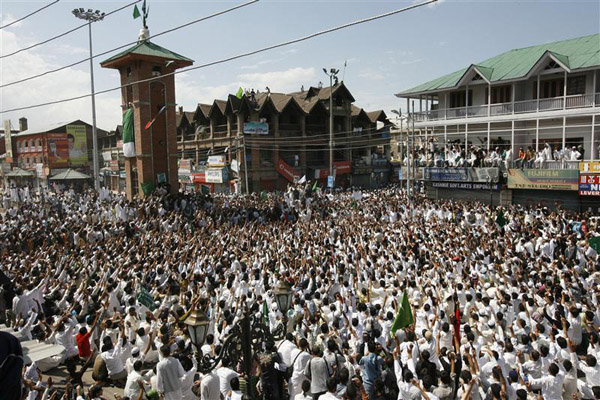
Dateline Lal Chowk
29th March, 2020
BABA UMAR
April 10, 2013
Srinagar
Named after Moscow’s Red Square, Lal Chowk in Kashmir’s Srinagar city has always intrigued me. It is an important part of Mughal King Jehangir’s paradise, at least for a person like me, who once frequented it almost every day. You can get lost in the labyrinth of its narrow lanes and by-lanes that all converge at Ghanta Gher (The Clock Tower), encounter people who mirror each other in complexion, experience bliss amidst hundreds of lined shops and street vendors.
However, the moment violence returns to this area, one can’t help but run home with a silent resolve not to visit this place again.
But it is Lal Chowk’s Clock Tower that pulls you back. For years it has stood tranquil while time has passed. From the scent of roses to the pungency of gunpowder, it has seen everything. So it is likely that anything associated with Kashmir should be cited under the auspices of Lal Chowk.
When I was young, I would wonder if I could climb this tower. I would imagine how the city would look like with me standing atop it. But I would not come up to its base. I would not touch its pedestal. It was taken over by the Indian soldiers. Just like other parts of the valley. I would always see a soldier resting his gun on a small window of the clock tower ready to pull the trigger from the pigeon hole. And I would feel the restlessness on the faces of passersby who would tread fast as they got closer to the tower.
During the first twenty years of my life, the mechanical clock fixed on the tower never showed the correct time. I don’t know when it stopped working, maybe it didn’t need to. Its sheer existence felt as if an old member of your family was watching you. You could never do anything wrong before its presence. I remember, as a student at Sri Pratap College, watching one of my colleagues stub his cigarette. Then, as we would walk past the Lal Chowk, he would say, “Somehow, I cannot smoke in front of this tower. It reminds me of my father’s friend, who died of bullets in Lal Chowk.”
Lal Chowk always reminds me of a seashore with Ghanta Ghar a lighthouse – guiding ships to safety. The two decades of violence saw the lighthouse intact, but ships going haywire. Soldiers had consolidated their position beneath, surrounded it with razor wires and sandbags. They would parade the locals every now and then. It is in Lal Chowk where Kashmir’s first premier Sheikh Abdullah and India’s first Prime Minister Jawaharlal Nehru announced mutual appreciation for each other. Abdullah had read a Persian couplet to honor Nehru’s friendship saying “Man Tu Shudi, Tu Man Shudi, Ta Kas Na Goyed, Man Degram Tu Degri (I became you and you became I; so none can say we are separate.)” And it was in Lal Chowk on November 2, 1947, that Nehru promised Kashmiris “a referendum to choose their political future” saying, “We’ve given that pledge and Maharaja Hari Singh has supported it. It is not only a pledge to the people of Kashmir but to the world.” Things changed abruptly later. Nehru’s promises died with his bones. The surprise checks, sudden grenade attacks, random firing, and arson would welcome the generations of Kashmiris in the future.
Even now, every moment I walk in Lal Chowk, I do not know what will happen out here. But the past several years have taught me to expect that people are always vulnerable on this street. In January 2010, I remember standing in a queue outside an ATM at Koker Bazaar, Lal Chowk, which is few metres from a massive paramilitary CRPF bunker that was targeted by Lashkar-e-Toiba gunmen (Recently a J&K Police beat replaced the bunker).
I arrived at the ATM and I checked my mobile phone for the time. It showed 1:40PM. In the beginning I was the last one standing in a six-man-long queue. But after couple of minutes, a lady and her daughter stood behind me. The guard outside the entrance passed a gentle smile probably suggesting that the ladies can come forward and withdraw money before everyone else in the queue.
As usual, the market, famous for dry fruits and Kashmir arts, was abuzz with customers. On my right, three CRPF men stood with automatic rifles guarding the sandbag bunker and their camp behind the burnt Palladium Theatre.
It must have been 1:45 PM when all of a sudden two of paramilitary CRPF men started running towards us. A bullet was fired at them, I suppose. We all panicked. And then it was a big bang. A grenade was flung, I understood. Within a fraction of a second, gunshots cracked the air. A wave of the crowd came running towards us. The queue broke up. I don’t know who went where. I pulled myself back towards the roadside. I ducked and I hurried. I know a trooper usually keeps his eye on the lane edge from a pigeon hole and a finger ready to pull the trigger, if attacked. And if he fires aimlessly in panic, it would be carnage in Koker Bazaar. That was the only thing I kept in my mind while running. The gunshots continued to punctuate the air until the sound graduated into a permanent mêlée.
I followed an old man, probably a pedestrian, through a narrow corridor into a shop that stored electronic goods. It was a few paces away from the ATM booth. Following me was a youngster who later told me that he was from Jammu and had visited Lal Chowk for the first time. And then two more escapees joined us.
Except for the elderly, who sat silently on a step, we all began calling our relatives. I called my brother. It was 2:10 PM now. I told him that I am alive but holed up along with five others in an electronic shop under a building somewhere behind Peak View Hotel. The hotel also faced the bunker but from the gunshots, he could gauge that I was very near to the battle site.
“Stay safe. Don’t come out until someone rescues you,” he suggested.
With fear consuming the youngster’s face, he told me that he had visited Lal Chowk for the first time and never expected that attacks like this would occur so randomly and quickly. “It is also for the first time that I had run so fast. How do you live in this city?” he said.
He was barely twenty, tall, young and clean-shaven. He wore a long black jacket, leather shoes, and blue jeans. He was accompanying his friend who had decided to stay in the car that they had parked in front of the Peak View Hotel. This building faces the traffic circle which saw troops and militants (now positioned in opposite Punjab Hotel) engaged in gunfight. After five minutes, the Jammu guy got a call. He picked up the phone on the first ring itself. “Thank God,” he said and smiled at me before he disconnected the gadget. “My friend is all right. He is also hiding in some shop.”
Between our short conversations, I saw him fret with horror as the sound of blasts and gunfire augmented. Then he too fired a barrage of questions.
“Why did they attack Lal Chowk? What will happen next? Are we holed up till night? Is this the first attack on the bunker outside,” he asked in one breath.
I could only encourage him not to panic. But he was a stranger in the town. A volley of bullets fired close by further scared him. He must have been invaded by countless thoughts of death and destruction.
To me, this wasn’t the first experience. I was used to it. As a kid, I experienced the conflict very closely when a Christian missionary school ‘Jesus Saviour’ where I had my elementary schooling was targeted with a grenade. The school remained shut for over a decade. The new school ‘Mehboob Public’ located in the inner city (then a bastion of pro-Pakistan fighters) would prove dangerous too. I was in the fourth class when militants took over the building to target an army patrol. I had remained trapped in a house behind the school for the entire day.
A few years later, in a firing incident near our locality, the Indian Army cordoned off our area and asked me to jump from a 10-foot long wall and ask everyone in a neighbour’s house to come out quickly or “we’ll machine-gun the entire house.” The panicky soldiers feared our house was being used to supply weapons and the neighbour’s house to target them, only to realise the next day that the fire had actually come from another locality separated by a 15-foot-wide drain and a huge government wasteland.
In 2005, when I was interning at Indian Express, a gunfight at Budshah Chowk almost drew me into the line of fire. That day, almost eight journalists received bullet injuries while Mohammad Muzaffar of Sahara News was lucky, even as he received bullet shots to the torso. I remember he had fixed his tripod and camera when the bullets rained towards us. I still remember the sound of a whizzing bullet passing close to my ear. Without calling anyone in office, I went home, ate and slept. Next day Muzamil Jaleel, my mentor at Express, slapped me and hugged me tightly. “You should have called us. We all were worried,” he said. For the entire night, he thought I was among the dead or wounded.
Such experiences and the skills acquired all the way through these years were enough to suggest that the Lal Chowk encounter wasn’t as deadly as the previous ones. Today, I was sure that we all would be rescued, within hours before dusk, if not now. Before I could say him anything the Jammu boy pledged never to visit Lal Chowk again. “If I survive today, I will never come to this place again. I swear,” he said.
Between our conversation and bullet fires, someone outside the road shouted “Come out. It’s safe.” I saw policemen downing shutters while a couple of police vans stood fixed on the edge of the lane.
I was the first to come out and then came the Jammu boy. I didn’t see him again. All of us leaped as fast as we could towards Amira Kadal. I took the Maharaja Bazaar road and reached my office at 3:30 pm.
The fresh gun battle had come three days after militants made an abortive attempt to blow up the bunker with a hand grenade and after two years after a Fidayeen squad [suicide squad] stormed a building close by. This attack, police would later reveal, was carried by two militants; Usman from Sopore in North Kashmir who was a recent recruit and formerly a painter (reportedly joined militancy after witnessing police/troops’ atrocities during 2008, 2009 unrest) and the other was a Pakistani militant identified by his first name, Qari.
Lal Chowk is peaceful these days. The new digital clock runs fine and the civic body ensures that it remains a garbage-free street but in the Red Square, fear is a constant comrade. That is what I’ve realised. Here, attacks could come as swiftly as they do elsewhere. Both luck, and how quickly you react, will determine your chances of survival.