Legal experts claim the J&K Assembly and the Cabinet have the power to revoke AFSPA in the state, says Baba Umar
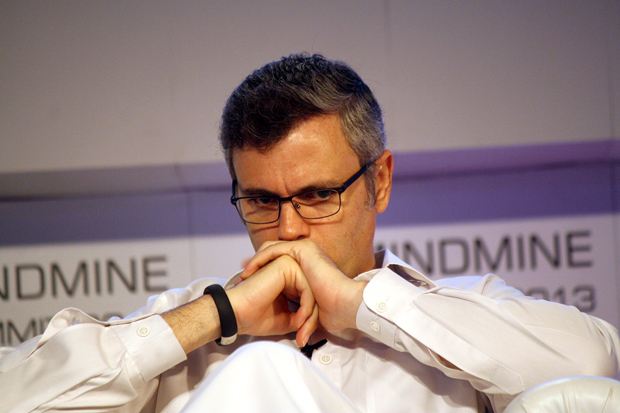
On 6 March, Tahir Rasool Sofi (27) of north Kashmir’s Baramulla town was allegedly shot dead by personnel of the 46 Rashtriya Rifles. Almost 380 km away, in the state Assembly in Jammu, Chief Minister Omar Abdullah nearly broke down when the news reached him.
He said, “I am tired of giving answers to people after such incidents.” The CM was questioning, yet again, the impunity that comes with the controversial Armed Forces Special Powers Act (AFSPA). In 2011 too, Omar had announced that AFSPA would go in “two days”, but soon had to chew his words.
All this suggests that the state is “helpless”, while the army and the Centre are to blame for the continued use of AFSPA. But legal experts believe there is much that the J&K Assembly can do about the matter.
Prominent Kashmiri lawyer Zafar Ahmad Shah points out a prevalent confusion regarding the AFSPA in J&K. “The Central Act called AFSPA 1958 applies to Arunachal Pradesh, Assam, Manipur, Meghalaya, Mizoram, Nagaland and Tripura. It does not apply to J&K,” he says. The Act enforced in the state was promulgated by Parliament in 1990 and is called the Armed Forces (Jammu & Kashmir) Special Powers Act (AF(JK)SPA). Section 3 of the Act gives both the Centre and the J&K governor the power to declare any part of the state as a “disturbed area”.
“AF(JK)SPA was enforced through notifications issued by the governor, with the support of the council of ministers, which first declared the Kashmir Valley as disturbed and later the Jammu region too,” says Shah. “So the Cabinet only has to ask the governor to withdraw the notification.” When a region is no longer deemed a “disturbed area”, the Act ceases to apply there.
“There is no need to approach the Centre,” he adds, “but the correct legal position was never clarified to the people in the state.”
Earlier, the J&K Assembly had declared the whole state as a disturbed area under the Disturbed Areas Act of 1997, which lapsed in 1998. Since then, disturbed areas have been notified only under Section 3 of AF(JK)SPA. The last time it was done was in 2001.
Today, Omar has a strong case for demanding revocation of the Act from six districts: Jammu, Samba, Kathua, Srinagar, Budgam and Ganderbal. These areas have seen littlearmy action for some years now. J&K Police sources claim there are no more than 13 militants (11 in Srinagar and 2 in Budgam) in five of these districts.
The remaining district, Ganderbal, serves as a transit corridor for militants moving south from the northern part of the Valley. Therefore it sees a fluctuating number of militants, but never more than eight at any point of time.
On 5 March, Omar said AFSPA should be repealed from areas where the army is not required and that the issue is being discussed with the Centre. “We’ve not put it on the backburner. I believe we are right on this issue,” he told the J&K Assembly.
Minister of State for Home Sajjad Kichloo told the Assembly that two committees — one for Kashmir and another for Jammu — have been formed to examine phased withdrawal of AFSPA. “Once the committee submits its report to the government, the matter will be discussed and taken up for consultation with the Centre,” he said, adding that the government is committed to revoke AFSPA from militancy- free areas.
But Srinagar-based columnist and rights activist Zahir-ud- Din says such statements are mere rhetoric as legal experts have repeatedly clarified that the J&K Assembly has the power to modify or repeal the controversial law. “Omar needs to take tangible measures instead of issuing statements and begging New Delhi to do the needful.”
So what stops the CM from moving forward on the issue?
In a recent interview, Omar blamed the pressures of coalition politics for the hesitation. “I would have to be pretty damn sure my Cabinet is behind me,” he said. “If I have the Congress on board on the decision in the Cabinet, it means I have them on board in the Centre — which means I could easily do it that way too.” (‘I don’t want to play politics over AFSPA’ by Shoma Chaudhury, 13 April)
The army, on its part, is clear that AFSPA must stay in place if the army has to operate in J&K. “The army is here because of an understanding between the state and New Delhi. We are here because the state government wants us to be here,” a senior army officer of 15 Chinar Corps told TEHELKA in Srinagar.
“AFSPA is an enabling Act. We can’t act without it.”
(Published in Tehelka Magazine, Volume 10 Issue 16, Dated 20 April 2013)