Kashmir: A long burning issue
29th March, 2020
Baba Umar
MyRepblica.com
22 Aug 2010
To the outer world, everything may seem hunky-dory in Kashmir. But inside the picturesque valley, situations these days are appalling. A single killing turns hundreds into mourners, and excesses on mourners push thousands to mutiny. The cycle of deaths repeats itself when soldiers and the local police kill another mourner with impunity.
The current strife, led by teenagers and youth that has caught both India and Pakistan off-guard, stems from a series of killings in the beginning of this year, followed by a couple of what are locally known as “fake encounters” up in the mountains where the Indian army claimed to have killed Pakistani infiltrators who later turned out to be civilians, and then a cyclic killing of some 60 people, mostly youth, by the Indian paramilitary CRPF (Central Reserve Police Force) and local police, all within two months.
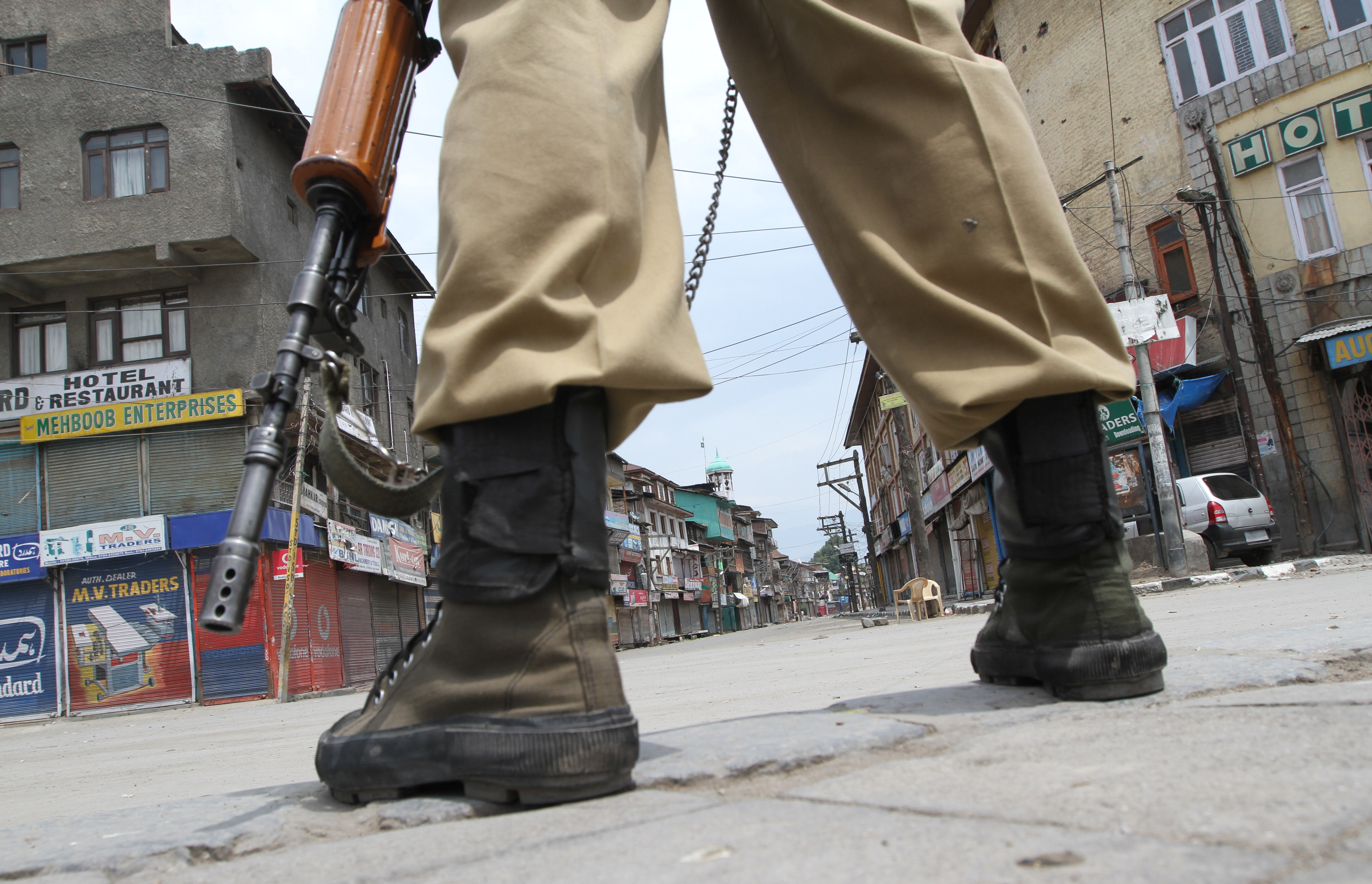
The city of Srinagar looks like what most journalists call “Groznied”, as they compare streets here to those of Chechnya’s capital. It continues to remain garrisoned ever since the teenager, Tufail Ahmad Matoo, was caught between stone-hurling protesters and the police, and was killed by cops when a teargas shell fired from a close range busted his skull.
Initially, the police statement was routine. It termed the student’s death “a mysterious murder.” However, autopsy established that the student, who was returning from tuition, was killed by a firearm pellet. It took some 36 days and two court orders for the police to register an FIR (First Information Report) on July 17, and began investigating the death. But by then, many more young, including Matoo’s cousin and a friend, were already shot dead, and the year’s summer uprising had well begun.
Every year, New Delhi and the state government mention normalcy with the arrival of hundreds of thousands of tourists to Srinagar and its hinterland picnic spots. However, the existing realities tell different tales.
The Kashmir Valley looks like a ghostly settlement. Its major towns, including Srinagar, continue to remain under curfew, evoking the memories of the early 1990s when soldiers would cordon towns, villages and hamlets, together for days, in search of militants and their sympathizers. Today, the only symbols of life are cantankerous soldiers patrolling streets and manning checkpoints, houses with broken windowpanes overlooking deserted roads, ambulances ferrying the injured to hospitals, and stray dogs and cows attracted to mounds of uncollected garbage.
As one drives from the airport and uptown, graffiti scream “We want freedom” and “Go India Go Back” till one leaves behind the infamous Dogra rulers’ crematories. In the twitchy downtown, youth gather on parapets of narrow lanes and boo the soldiers who watch the alien and hostile crowd from their pigeonholes and mobile bunkers. And as stone projectiles hit the soldiers, symbolic of the disagreement over the Indian rule in Kashmir, teargas shells and bullets are fired in response, many times directly on the youth, who form close to 70% of the population in the Muslim-majority state. A new casualty feeds the next phase of protests and demonstrations, coupled with the soldiers’ onslaught.
Bereft of any idea how to control the civilian population, Delhi initially chose to remain silent, suggesting the wave of anger to be handled by the state government only. After the state’s Chief Minister shuttled between Srinagar and Delhi, a Home Ministry report was aired by Delhi-based media that protests were instigated from beyond the LoC (Line of Control) by the Pakistan-based and banned Lashkar-e-Toiba. However, it failed to develop a consensus among the various political parties and people who thought that a frustrated Delhi sidelined the common anger and tried to hoodwink the world.
And public outrage has doubled with the state government arresting hundreds of youth for rock hurling and detaining all the separatist leaders, including the popular Syed Ali Shah Geelani, under the notorious Public Safety Act (PSA), which also swept lawyers who fight their cases and imposing an embargo on the news by banning SMS service, prohibiting local journalists’ movement and scuttling the airtime of local cable news. Kashmir was soon reported on by reporters who are locally called “chopper journalists” who flew from Delhi only to be reacted sharply against by youth both in the streets and in the cyber world.
On such social networking sites as Facebook and YouTube, savvy youngsters gave their versions of the events.
In South Kashmir’s Islamabad, when police claimed to have killed three protesters for arson and damage to public property in the streets, an amateur video shot from a mobile phone was uploaded on YouTube that showed images of youngsters killed on the lawn of one of the victims’ house.
In another case, an eight-year-old boy, Sameer Ahmad Rah, became and still remains the youngest victim of this year’s phase of violence. While the police maintained that the boy died in a stampede, locals, as well as his fruit-vendor father, insisted that he was beaten and tossed out of the retreating forces’ vehicle and died in a hospital ventilator. His image still draws condemnation, and remarks of vengeance are made on the social networking sites.
India’s and its media’s sincerity is always questioned here, and their credibility is so low in the Valley that nobody wants to believe their version of events.
Today, one can draw parallels between the existing situations and what happened immediately after 1989 when the armed rebellion broke out against New Delhi’s rule in the state. There is the same amount of defiance – this time with stones – anti-India sentiment, pro-Azadi (freedom from India) slogans, and thousands of demonstrators in the streets. This time, in addition, the participation of children and women in these protests has been overwhelming.
Under treatment in a city hospital, 16-year-old Owais War was shot in the abdomen in his village in north Kashmir and survived by a hair’s breadth. The bullet escaped his body from his right buttock. However, his uncle Khursheed Ahmad died on the spot when the duo walking to a marriage ceremony was fired.
The killing has hardened his stance on the Kashmir conflict, which he thinks can be won by youths with stones only. “We can’t stop pelting stone. This is the only way left to confront the troops,” he told me.
I talked to Zaitun Begum of Gungbugh on the city’s outskirts. Years ago, in her college days, she would join peaceful protests. But these days, she spearheads protests in her area after her government employee brother, Fayaz Ahmad, was shot dead by soldiers.
Others have built small war memorials in their homes.
The mother of Tanveer Ahmad Handoo – killed in the summer of 2008 – keeps her son’s poster-size picture by her spinning wheel. It reminds her of the entire journey of Tanveer’s, from his birth to being shot dead. She has also seen a YouTube video that shows images of her dying son hit by bullets and succumbing on the way to hospital, which she says is her proud possession.
In another house, the mother of Wamiq Farooq keeps her 14-year-old son’s belongings – a red tie, a crimson belt, a white shirt, laminated birth and death certificates – in a brown suitcase. Wamiq was killed when a teargas shell fired by the police exploded on his head, shattering his skull and brains.
“This war is now a war against forgetfulness. They (authorities) want us to forget our pain. But we’ll come out in the streets to demand freedom for those who survive,” she says.
The current anger against India is so intense that separatists, too, have to face public wrath. The youths’ outrage meted out to the Pakistan-administered Kashmir-based United Jehad Council chief Syed Salahuddin and senior separatist leader Syed Ali Shah Geelani reflects this.
When Salahuddin suggested to the youth to adopt a more flexible approach, go slow on hartal (shutdowns) and allow people to buy food and let children study, his effigies were burnt in his traditional bastion of Sopore in north Kashmir. He swiftly changed his statement and issued a clarification.
Similarly, Geelani’s suggestion not to burn down police stations and government vehicles, too, was not taken well by the protesting youth who consider all state symbols as “tools of tyranny.”
Not only separatists, but even pro-India politicians have also avoided meeting youth or mourners, fearing backlash and even lynching. “The situation has reached such a level where we’re being termed as Indian dogs,” opposition leader Mehbooba Mufti told a news channel recently.
Chief Minister Omar Abdullah and his advisor Mubarak Gul had to cut short their visits to city hospitals after facing angry attendants and hostile crowds.
While Pakistan presently remains occupied with its flood situation, India seems to stretch time as usual and does nothing substantial to address the youth’s demand and resolve Kashmir’s vexing conflict.
However, that strategy seems to be failing, keeping in view the current unrest that both the police and soldiers are finding it hard to deal with.
“It’s easy to kill 10,000 militants on the roads but really difficult to handle kids who are carrying only stones to hurl,” a senior police official, while observing his colleagues battle stone-pelting uptown youth, recently told me.
http://www.myrepublica.com/portal/index.php?action=news_details&news_id=22372