November 26, 2011, Issue 47 Volume 8
In 1996, four people were bundled into a police van. One escaped, while there’s still no news of the other three. Baba Umar travels to Bhaderwah to expose the cover-up
JAMMU AND Kashmir Chief Minister Omar Abdullah wants the removal of the Armed Forces Special Powers Act (AFSPA) in four districts, claiming the police is well placed to maintain law and order. However, in Bhaderwah area of Doda district, local ire is directed against the police. Here, relatives of three villagers — reportedly shot and dumped into the river Chenab in 1996 — are seeking re-investigation into the case in which a Crime Branch report already indicts J&K’s top cop and current Director General of Police (DGP) Kuldeep Khoda.
Police records claim that three civilians were shot by Muslimmilitants in the area. Later, however, they claim there was bitter animosity between the victims and the key accused Muhammad Ashraf, a special police officer (SPO) and village defence committee (VDC) member. Families of the victims vehemently deny this. Interestingly, the Crime Branch report, a copy of which is with TEHELKA, was never produced by the prosecution in the trial court, leading to the acquittal of the key accused and leaving the role of the DGP unchallenged.
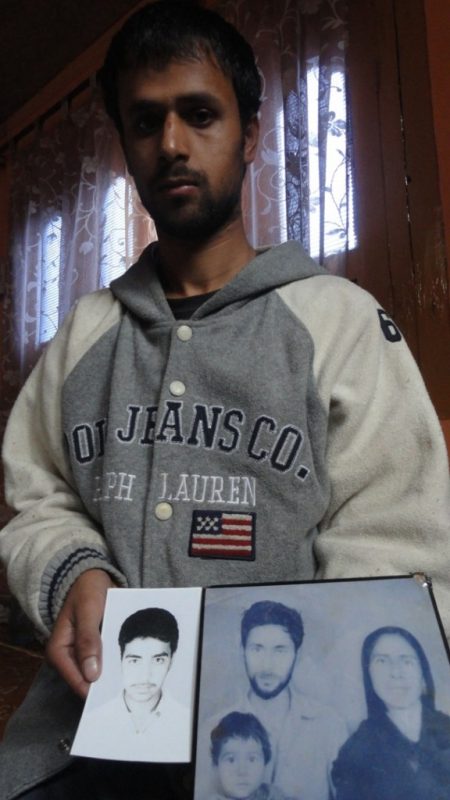
TEHELKA travelled to Malini village of Bhaderwah town to find out how, despite police intimidation, families of the victims are fighting for justice. Almost 15 km away from Doda city, Malini is a picturesque but rugged world surrounded by jagged peaks. At the foot of a lush mountain, among the cluster of wooden huts and old brick houses, Nazira Begum, 45, and her son Shahid Hussain Dar, 25, remember the night when Begum’s husband Fazal Hussain Dar and her other son Fareed Hussain Dar were picked up by three masked men. With the father-son duo, two more villagers — Muhammad Hussain Lone, 24, and Talib Hussein, 50 — were forcibly taken from their houses by Ashraf of Pranu village.
“They bundled the four of them in a police van and sped away. Since then we haven’t heard from them,” says Begum, who along with many villagers searched for the missing men for three days until Talib Hussein returned to tell the police and villagers that the abducted were shot 12 km away at Prem Nagar on the Doda- Kistwar road and pushed into the Chenab river.
When TEHELKA met Hussein at Begum’s house, he refused to speak about the incident. Apparently under intense police pressure, he said in a faltering voice: “My version is with the court. There is nothing more to say,” adding, “Anybody would be scared. My beard turned white within a week of the incident.”
The families live under intense police scrutiny, so much so that they have been told to avoid the media. They also fear their phones are being tapped and their movements regularly monitored. Also that those who visit them, like this TEHELKA reporter are spied upon.
In her in-laws’ house at Bhaderwah town, Arifa Banu, 21, and her sister Ayesha Banu, 20, however, are putting up a brave front against intimidation and calls for compromise. They are the daughters of Muhammad Hussain Lone, a farmer who used to till his land before that fateful night. “They (police) want us to compromise,” they say. “We tell them, ‘Bring our father back or hang his killers’. Even yesterday, someone called to warn us of consequences if we spoke to the TEHELKA journalist.” Adding, “At least people unburden their hearts at the graves of their relatives. But we don’t even have our father’s grave to mourn at.”
About Muhammad Ashraf, she says, “I don’t know why police reasoned the killings as an outcome of enmity between Ashraf and us. We never knew him until the police arrested him and produced him in court. He was closer to the police than anyone in the area.”
Truck driver Shadi Lal says that before kidnapping and killing the three civilians, Ashraf went to DIG Khoda’s residence
The case has seen many twists and cover- ups. Police truck driver Shadi Lal’s testimony to investigators indicated that SPO Muhammad Ashraf, who was later arrested, played a major role. During reinvestigation, Shadi Lal said that he was posted in Doda as the driver of police truck JK02C 9597 and he knew Ashraf as a police informer. He told the Crime Branch that Ashraf used to get police vehicles and other Personal Security Officers (PSOs) whenever he wanted. Lal also said that before kidnapping and subsequently killing the three civilians, Ashraf went to the residence of Khoda, the then DIG. Despite repeated requests to give his side of the story, via SMS and email, Khoda did not respond till the time of going to press.
Earlier in 1996, Fazal Hussain’s widow Nazira Begum, citing conspiracy by police officers, approached the National Human Rights Commission (NHRC), which summoned the then DGP and IGP of Jammu and sought reinvestigation by the Crime Branch. The case was again probed by then Additional SP (Crime) Bachan Singh Choudhary.
His progress report dated 16 January 1998 indicted Khoda, who was DIG (Doda-Udhampur range) at the time of the murder. Only 10 days after Choudhary’s report, which was also sent to the then DGP Gurbachan Jagat, he was transferred. In a new report prepared on 12 November 1998, Additional SP Shikha Goel, who took Choudhary’s place, confirmed many aspects of her predecessor’s report and also mentioned tampering of evidence.
In 1998, however, the Bhaderwah Police Station produced the case in the sessions court without mentioning the NHRC intervention and subsequent re-probe CL/PA- 122-25 by the Crime Branch. Surprising, considering the report had many points that would have made involvement of many parties quite clear. Some of the findings in the Crime Branch report are:
— Muhammad Ashraf meeting Kuldeep Khoda, before and after the gruesome killing of three civilians, is a grim pointer to a situation in which an irresponsible person was given a long rope.
— DIG (Khoda) ought to have deputed a proper police contingent under the command of responsible officers to accomplish the task if it was meant to contain militancy. Instead, a free hand was given to the accused, which ultimately culminated in the death of three persons.
— The clout enjoyed by Muhammad Ashraf can also be gauged from the fact that he was issued a prohibited weapon — an assault rifle — in violation of norms. He had also collected two more rifles with ammunition for himself and two associates from the Assar police post, saying they were VDC members, which they were not.
— Khoda refused to get the accused arrested by the Batote or Doda police, even though the truck driver said that a heinous crime had been committed. Delays by district authorities meant only one accused could be arrested while his two accomplices are still at large.
— DIG (Khoda) ought to have deputed a proper police contingent under the command of responsible officers to accomplish the task if it was meant to contain militancy. Instead, a free hand was given to the accused, which ultimately culminated in the death of three persons.
— The clout enjoyed by Muhammad Ashraf can also be gauged from the fact that he was issued a prohibited weapon — an assault rifle — in violation of norms. He had also collected two more rifles with ammunition for himself and two associates from the Assar police post, saying they were VDC members, which they were not.
— Khoda refused to get the accused arrested by the Batote or Doda police, even though the truck driver said that a heinous crime had been committed. Delays by district authorities meant only one accused could be arrested while his two accomplices are still at large.
In an attempt to cover up the crime, the re-investigation report was never produced before the court by the prosecution.
And finally on 8 November 1999, Judge Bihari Lal Bhat observed that the prosecution case appears to be somewhat “strange” and that the “prosecution brought on record is weak, infirm and unconvincing of the same, does not establish the guilt of the accused beyond any shadow of doubt”. Thereby, Ashraf was acquitted of all charges while the remaining two accomplices are still at large.
IT WAS after almost 12 years that someone anonymously leaked the Crime Branch report to the media, raising hopes of justice among the victims’ family members. “We were surprised when we learnt about it. Now the police have much to answer for,” says Arifa, whose mother Shaheena Begum has filed a petition in the Srinagar High Court seeking “reinvestigation into the triple murder and alleged involvement of the DGP Kuldeep Khoda in the killings”.
Noted human rights activist and advocate Parvez Imroz, who is pleading the case on behalf of the aggrieved families, told TEHELKA that the families feared for their security and were sceptical about a fair trial in the Jammu Bench of the Srinagar High Court.
“Pressure on families began on Day 1 of the murder. Besides, lawyers in Jammu were not interested in fighting the victims’ case. Many cited exorbitant fees. So we sought permission from the Chief Justice to allow the trial to take place in Srinagar,” he says.
Supreme Court lawyer Prashant Bhushan too appeared in the J&K High Court as the victims’ counsel on 30 September this year. He pleaded before Justice Hasnain Masoodi that J&K government “should show seriousness” in the case and expressed concern that the Advocate General of the J&K government was not present with all relevant records. In the next hearing on 5 November, the Advocate General sought two weeks’ time to produce all the records lying with the government.
The Crime Branch report points out that responsible officers should have been deputed if it was really an anti-militancy operation
While there have been three hearings in the case so far, the position of the J&K Police chief, retiring next year, seems to have become susceptible. The news has been mostly played down by the local media while both separatist and mainstream politicians have preferred to remain silent. Leaving Shahid Hussain Dar, son of Fazal Dar, to wonder what his father and brother would have told their killers when they were shot and thrown into the Chenab.
“That’s the rock where we found my father’s blood, slippers and a portion of the sweater he was wearing,” Shahid points towards a grey rock on the river bank. “Either inside the police van or here on this rock, my father and brother must have surely asked why they were being killed. I wish someone could tell me,” he says.
(Published in Tehelka Magazine, Volume 8 Issue 47, Dated November 26, 2011)