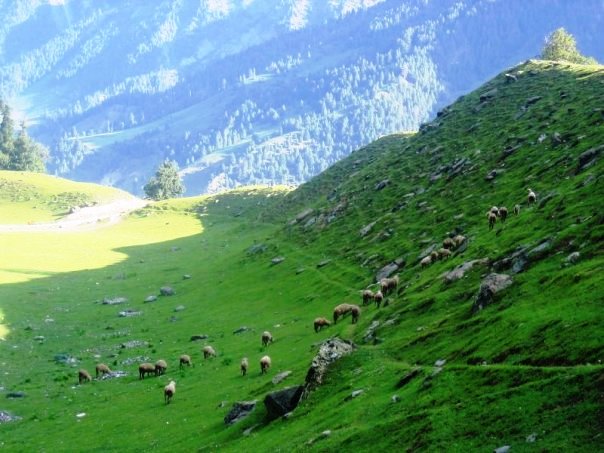
Just a kilometer before Sonamarg, in the lap of nature, on the green rug, eight small tents are pitched in a row. Each in the shape of an octagon. Tucked next to a road that leads to famous Thajiwas Glaciers, these tents juxtapose with the sparkling stream (Sindh) that gushes loudly below the edge of a meadow on which sheep graze in thousands.
Outside these tents, Showket Ahmad, the first Kashmiri to have led expeditions to a couple of initial base camps of the world’s highest peak, Mount Everest enjoys the warmth of the big orange sun that had just emerged from behind the Himalayan ranges.
Donning sports gear, Showket a visibly stiff, red-faced round man with deep wrinkles on both cheeks sits in a wing chair.
As he puffs a cigarette sending in air loops of smoke, he opens up.
“I am leading a team of ‘Highland Excursion Pvt Ltd’—an offshoot group of Australian adventure sports firm ‘World Expeditions’,” he finishes pointing towards a van with the agency’s name inscribed on its white coating.
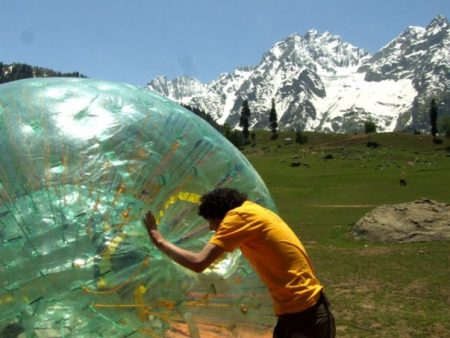
These days Showket’s team takes incoming tourists for rafting in Sindh and Zorbing or Sphereing (adventure sports wherein a person travels in a huge round ball, generally made of transparent plastic) on the slopes.
“It is a new concept here. People are picking up,” he says, while a young man rolls down the green slopes—Sphereing.
Having mastered adventure sports and a hardcore travel aficionado, Kashmir’s beauty and thrills involved in its exploration injected in him a ‘Strange fanaticism’.
“I was born in Kashmir which obviously attracts everyone but it made me its bed-fellow. The first time I went up in the mountains I decided to conquer the Himalayas. And play in its lap,” he says easing his forehead ruts.
Born in the city’s Khanyar, Showket had his primary studies from Biscoe School. He was insisted by his parents to be in civil service after graduation; however, he refused his father’s suggestion.
“Rather, I chose to become a fashion designer. For some time I kept myself busy with it, but the aim was to be in adventure sports,” he says as he fiddles with his sports watch.
He quickly drops his hand in a shirt pocket and comes out with an I-Card reading his designation and job at the Women’s Polytechnic, Bemina where he would teach in 2003 till 2006.
Besides, he would also spend some time participating in several rafting and skiing events across India. And the autumn of 2006 saw him leading an expeditionary team to Everest.
“That was an amazing experience,” he says hurriedly with bright eyes that shine like a diamond. “But it was only till the base camp 1 and base camp 2.”
It costs around 20 lakh rupees to get on to the summit of Everest, and Showket’s company had fixed him for the first two base camps only—both at the height of more than 6,000 m above sea level.
“Thereafter Sherpa’s are the best guides,” he explains.
In school, Showket had trekked Mahadev and after some years, he trekked to Kolohari, Annapurna Daulagari, Everest Circuit, and Gokyo Lakes—all in the Himalayas and each site a 20-day snowy trek. Months after the trip, Showket was soon skiing with the famous Australian skier and Everest Climber Nick Farr. Not once but several times.
However, it was Everest which he never went for. But he is planning for it.
“This company pays me good, and God willing, one day I will hit the Everest summit with my 10-year-old son,” he smiles showing for the first time his white teeth.
And once on the tip, unlike others, he will not be pitching any flag or a memento, but he will do something unique.
“I will light a cigarette there,” he says making himself sit relaxed.
“I don’t believe in boundaries and nationalities. I am the child of this planet and the whole world is my playground.”
There are other aspects of Showket’s specialization.
When he was in Fashion Designing, he managed to produce an unpublished dictionary on the fashion designing terminology.—a feat first by any Kashmiri.
“‘A-Z of Fashion’ was its name. But it didn’t get published,” he says. His work was supposed to be published by Prentice Hall, a New Jersey-based publisher of academic and reference textbooks and technology.
“But it didn’t mature,” he says.
It was in the year 2006 when he finished its compilation and the same year he left his job in polytechnic and joined Highland Excursions.
Most part of the year, Showket stays outside his home and he hardly gets to see his family. But he says, it has hardly affected any relationship.
“My dad knows me. He understands my profession and my likings. Even the lady, I got married was told much before the wedding that the person would spend most of the time in the jungles and mountains,” he laughs for about a minute.
He says he is thankful to all of them as such a job needs everyone’s blessing and satisfaction.
As we talk, he seeks information from his colleague about a tourist’s health, who was injured while rafting in the Sindh.
“He is okay now,” Showket’s colleague reports.
The conversation also gets interrupted when another colleague, Joti of Nepal, complains of pain in the abdomen and ribs.
“Go and get the tablets from the first aid box,” Showket points his fingers towards the box. “Have some tea and take rest.”
“He was also injured during rafting,” Showket says.
Joti’s condition takes Showket straight into a flashback, to a time, when he was also badly wounded during a Parasailing attempt over the Dal Lake in Srinagar.
“I was actually treading a Parasailing world record,” Showket adds.
Showket recalls the summer of 1998 when he tried to create a world record by trying to claim an unaided 330 feet freefall from a parachute over the lake. It risked his life as the attempt couldn’t be recorded while he wounded himself fatally.
“Everything was going as planned. But as the boat pulled me up, a sudden jerk off-loaded me midair detaching the rope with the boat,” he explains using his hands to emphasize.
The cameraperson in the boat had him in the frame initially but the jerk caused imbalance and he lost his control.
Showket was nowhere in the frame.
The next moment saw Showket towering over the Lake. And he saw himself saying ‘Leave the parachute’.
“As soon as I left it, the upward pull kept me suspended for about a second in air. And then I came down like a meteor,” he says.
The contact with the water surface was so firm that it sent a splash of water in the air with the diver successful in his feat. As the waves spread constantly over the surface. There was no movement in the water. Just a huge bubble burst. Showket was fished unconscious. The impact had ruptured his eardrums, a mid-rib hanged by the skin as the blood mixed with the water. His chest bled profusely.
To his shock, nothing was recorded.
“I was successful in creating a record, but I needed to prove it through a camera. I was nowhere in the frame,” Showket says in a low voice.
He did not try it next time. He was sad. Not because he had evaded death, but his bravado remained unrecorded.
Visibly disturbed but content deep downwards, Showket scratches his head, tries to ignite a half-puffed cigarette that was doused hours back. No one speaks for a moment. And then the conversation begins with a cup of tea.
“I am mad about cigarettes and tea—my permanent companions,” he says between a couple of sips.
The sun starts descending, scattering red flash till the mountains that stand guard on the rims of bowl-shaped Sonamarg.
Shadows of these blue-coloured tents begin lengthening till they permanently halt while hooting shepherds come down from slopes with the herd.
“Pack up boys,” Showket gives a call. Colleagues start rolling up raft boats and green plastic sphere.
“Expedition to these mountains,” he says, “is never an easy-going”.
“It is like eating grass and struggling because your food supply is running low. Or perhaps it’s the adventure of using water can for three days in a ferocious blizzard outside your tent. And all it needs one to be a fanatic.”
