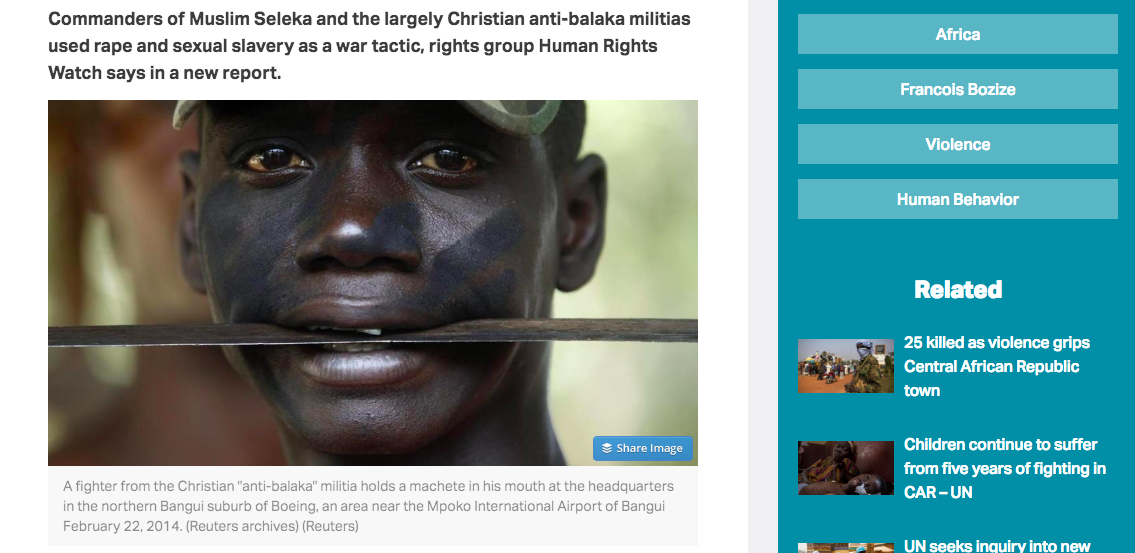
Militia bosses used sexual violence as ‘war tactic’ in CAR

Commanders of Muslim Seleka and the largely Christian anti-balaka militias used rape and sexual slavery as a war tactic, rights group Human Rights Watch says in a new report.

BABA UMAR 5 OCT 2017

Source: TRT WORLD

Commanders of armed groups fighting the five-year-old civil war in the Central African Republic (or CAR) have used sexual violence and torture as a weapon of war, Human Rights Watch (HRW) said in a report   on Thursday.

The international rights body said it has documented over 300 cases of “rape and sexual slavery” against 296 women and girls by members of Muslim Seleka and the largely Christian anti-balaka group.

The African country has been beset by violence since 2013 when the Seleka rebels ousted president Francois Bozize. Seleka’s rule in the Christian-majority country sparked a deadly backlash from the pro-Christian anti-balaka militia.

“Armed groups are using rape in a brutal, calculated way to punish and terrorise women and girls,” said Hillary Margolis, women’s rights researcher at the rights body.

“Every day, survivors live with the devastating aftermath of rape, and the knowledge that their attackers are walking free, perhaps holding positions of power, and to date facing no consequences whatsoever.”

The 176-page report said that commanders of these groups “have tolerated widespread sexual violence by their forces and, in some cases, appear to have ordered it or committed it themselves.”

Because many cases are under-reported due to the social stigma attached, HRW said, the exact number of cases of sexual violence is unclear but “undoubtedly higher”.

It said the abuses constitute “war crimes” and in many cases “crimes against humanity”.

Anneke VanWoudenberg

@woudena

Rape as a weapon on war MUST stop. New report by @HRW shows the horrific scale of in . https://www.hrw.org/news/2017/10/05/central-african-republic-sexual-violence-weapon-war 

Central African Republic: Sexual Violence as Weapon of War

Armed groups in the Central African Republic have used rape and sexual slavery as a tactic of war across the country during nearly five years of conflict. Commanders have tolerated widespread sexual

hrw.org

Sexual slavery and death threats

Survivors told HRW researchers stories of gang rapes, physical assault, torture, sexual slavery and death threats committed by both the armed groups.

One survivor Jeanne (name changed), 30, told HRW investigators that she along with nine other women and girls were seized by a group of Seleka members in June 2014.

“The first day, five Seleka raped me. Every day we could not rest – every day there was rape, by different fighters,” Jeanne told the investigators.

The captive, who was also subjected to sexual slavery, remained at their base for six months.

“Each fighter who arrived at the base, it was to rape us. If we refused, they hit us … I went to look for firewood. I drew water, looked for water at the river, prepared their food. All of the women did this. All the women were raped each night,” she told HRW.

HRW quoting another rape survivor Rachida (name changed) said, “Each day, four [anti-balaka] came to have sex with me in the morning. Then five men at 3 pm and again at 7 pm. In the morning four men, in the afternoon and evening, the commander plus four men.”

Yasmin Khatun Dewan

@Yasm1nK

Great report from @hrw on as a weapon on war in “Women won’t accept impunity anymore” https://www.hrw.org/news/2017/10/05/central-african-republic-sexual-violence-weapon-war 

Special courts

Many survivors, who never got justice, became pregnant and were shunned by their relatives.

Survivors have identified six individuals in leadership positions of an armed group responsible for sexual violence against the women.

HRW sought immediate functioning of the newly established Special Criminal Courts (SCC) in the country.

“The court, which includes national and international judges and prosecutors, can help break the country’s entrenched impunity, but success will require sustained financial, logistical, and political support,” HRW said.

Click here to read the full report.