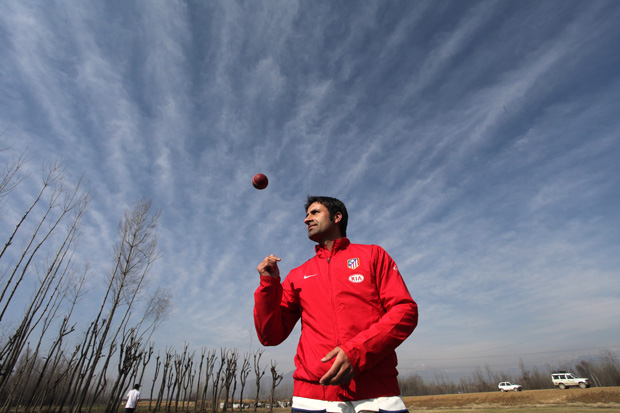
Parvez Rasool: I should be in Indian cricket because of performance, not where I come from
10th December, 2018
The faded red cherry left the young bowler’s right hand. Matthew Wade, the aggressive Australian cricketer, charged. The delivery was a flighted off-breaker. A perfect deceiver. The stand-in Aussie skipper misjudged the length, sending the ball high into the air to be caught at long-off.
For Parvez Rasool Zargar, the 24-year-old Kashmiri all-rounder, it was his “most cherished, career-best” wicket. He took six others in the two-day warm-up between the Indian Board President’s XI and the touring Australians last month.
He also scored 36 runs, the second highest in the first innings. “Taking wickets and scoring runs tastes different now,” says Parvez. Having already reached the highest level of cricket played by any Kashmiri, he now presents the Indian selectors with a luxury problem: how to fit him into the side at international level.
He was raised in the pro-Azadi bastion of Bijbehara in South Kashmir, amidst gunfire and curfews that lasted days.
“Parents wanted their children to study,” says his father Ghulam Rasool Zargar, “to become doctors or engineers. But I always wanted my children to follow cricket.”
Ghulam himself was a roller operator in the government’s mechanical engineering department, but perhaps his passions were more engaged in the cricket he played at district level. The growing civil unrest in the Valley put paid to any cricketing aspirations he might have had but he was determined that things be different for his boys, Parvez, Asif and Umar.
All three have represented Jammu and Kashmir at tournaments. “You have to be lucky to be born into such a family,” Parvez says, “for whom cricket is more than an amusement, a game for kids who can’t excel at science or mathematics.”
His supportive father and cricket-playing brothers aside, Parvez also found a mentor in Abdul Qayoom, once the poster boy of J&K cricket. Qayoom, who also happens to come from Bijbehara, spotted Parvez as an 11-year-old at the local sports club where he coached children.
“When I first saw him in the nets, he would bat well and keep wickets. Then, one day, he insisted on bowling to the tail-enders. He finished them off one by one and then I knew he was a talent, a real all-rounder.”
Parvez went on to play club cricket in Srinagar at various levels; he played for another youth team, coached by Qayoom, that travelled extensively, giving him experience under all conditions. Another marker of his promise, Qayoom says, is how quickly he picked up what his coaches were trying to show him and how easily he adjusted.
Parvez’s appearance belies his athletic prowess. Of average build, with short hair, a long nose and brown eyes, he looks humble, though the intensity of his gaze may hold your attention longer than most.
He’s shy too, religious, loath to talk about things other than cricket. He won’t even speak of the time in November 2009, when the police in Bengaluru accused him of carrying explosives in his kitbag.
A few days later, the forensics report exonerated him completely. Rajesh Dhar, a working committee member of the Jammu and Kashmir Cricket Association (JKCA), another of Parvez’s mentors, recalls, “At the airport, a sniffer dog began to sniff at his bag. Parvez keeps his Quran in the bag and was reluctant to have the dog come too close. This evoked suspicion and there were all these media headlines about explosives and terrorists.”
Parvez proved his mental strength though, telling Dhar that the incident only made him more determined to become a professional cricketer. He was true to his word, scoring four consecutive half- centuries against the formidable bowling attacks of Karnataka and Kerala.
He’s gone from strength to strength. In the recently concluded Ranji Trophy, Parvez scored 594 runs and took 33 wickets in just seven matches, the best performance by a Kashmiri in the tournament’s history. It’s just another among a string of firsts: in both seasons of the Deodar Trophy, Parvez was the only J&K player picked for the North Zone side captained by Virat Kohli.
In January, he became the first Kashmiri cricketer, and only the second from the state, to play for India A, against England in New Delhi. The national selectors invited him to join the national team’s camp. “I was so happy,” says Parvez, still visibly elated, “to be a part of the side, to bowl against Dhoni and Sehwag.” As if he still can’t quite believe it, he adds, “I travelled with them on the bus and they talked to me, joked with, shared their experiences.” He’s going to have to get used to it.
Dhar compares Parvez as a player to Ravichandran Ashwin. In April, Parvez will don the black jersey of the Pune Warriors, joining Ashwin and other stars of world cricketin the Indian Premier League (IPL). “Many teams wanted me,” Parvez says, without seeming brash, “but Pune Warriors asked first. I hope playing well in the IPL will convince the selectors to pick me for Team India.”
His achievements as a player are astonishing because of the odds stacked against cricketers from Kashmir. The weather, for a start, leaves fewer months to play cricket than in most other parts of the country and the lack of infrastructure means many club teams are forced to quit.
The JKCA holds two three-day trials to assess young players but many claim these are partisan. Then there are reports of corruption within the board and the siphoning of funds worth crores last year.
An enquiry into the scam is still being conducted by both the JKCA and the police. The army hosts tournaments too, part of its drive to “win hearts and minds”, but the calibre of player these tournaments attract is not high enough to test the best young players.
In fact, it’s players like Parvez that are most likely to win hearts and minds. In parts of the state, Pakistani ‘green’ has traditionally been preferred to Indian ‘blue’.
People still remember the boos that greeted Kapil Dev’s India in a 1983 one-dayer in Srinagar against the West Indies whose every run was cheered to the rafters. The support for Parvez might encourage a few to extend that support to India.
Of course, old habits die hard. Shabir Bhat, a cricket fan in Srinagar, puts it this way: “If it’s a game against Pakistan, I would like to see Parvez play well in a losing effort. But that doesn’t matter, Parvez should be encouraged. He deserves to be in the Indian side.”
For Parvez, it can’t be easy shutting out the political implications of his selection in the Indian squad. A recent newspaper story quoted sources claiming that the Indian government might try to defuse political tensions in Kashmir by ensuring Parvez is “fast-tracked into the national side”.
A news agency meanwhile reported that Parvez had posted on Facebook that he had a “definite chance to play for India. Nothing is impossible”. Parvez says the account is fake. He might actually want to stay on the sidelines a little longer rather than become a political symbol for enforced peace in restive Kashmir.
It may be wishful thinking, but as he says: “I should be in the Indian side because of my performance, not where I come from. I’m a professional cricketer.”
Published in Tehelka magazine, volume 10 issue 11, dated 16 March 2013