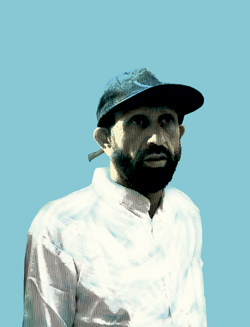
Will this man’s arrest dissuade former militants from returning in search of a new life, asks Baba Umar
LIAQUAT SHAH, 45, never intended to be a trigger. But his disputed arrest by the Delhi Police could end up having tremendous long term impact. Ever since a high-octane debate broke out between the J&K Police and the Delhi Police over Liaquat, two things have come into focus: one, the murky world of intelligence agencies, and two, the flawed surrender policy of the J&K government.
On 20 March, Delhi Police announced it had busted a terror module by arresting Liaquat at the Indo-Nepal border, and claimed he was a Hizbul Mujahideen militant. Soon after, the J&K Police claimed that the arrested man was a former militant who wanted to surrender. This is how the story unfolded.
Liaquat had reached the Indo-Nepal border on 19 March with his third wife Akhtar-un- Nisa and stepdaughter Jabeena Geelani. The pattern of homecoming was similar to that followed by 300-odd former militants, who had crossed the LoC in the 1990s and returned only after the J&K government announced a surrender policy in 2010. Liaquat’s destination was his home in Dardpora village of Kashmir’s Kupwara district.
But at the Sanauli check-post on the Indo- Nepal border, he was ‘seized’ by a posse of plain clothed men. Soon, the Delhi Police claimed to have arrested a top militant who was about launch spectacular attacks in Delhi just before Holi. The police also said they raided a hotel room in old Delhi where Liaquat’s would-be host had left an assault rifle, several grenades, maps and dry fruits before running away.
“We entered India through Gorakhpur in Uttar Pradesh and approached the SSB (Sashastra Seema Bal, a border guarding force),” says Akhtar-un-Nisa, who reached the Kashmir Valley after days of ordeal. “Liaquat was handed over to the Delhi Police, not the UP Police. We were told that he too would be released after questioning.”
Doubts were raised about the Delhi Police version as more information emerged, with Liaquat’s first wife Ameena Begum and his brother Inayat Shah claiming that he had surrendered at the Sanauli check-post and “not arrested”.
“He came here to surrender and get rehabilitated. And the J&K Police knew this,” says Inayat. “If he planned to launch terror attacks, why would he surrender to the SSB? Why would he come with his wife and a daughter?”
The J&K government and police were soon backing the family’s claim. According to state government officials, Ameena had applied on Liaquat’s behalf for benefits under the rehabilitation policy in February 2011. “So why did the J&K Police file a case against Liaquat hardly a month later?” asked DCP (Special Cell) Sanjeev Yadav of the Delhi Police, talking to the media.
“The FIR in that case names Liaquat as accused No. 84 in a list of 97 charged with waging war against the Indian State and criminal conspiracy,” he added.
But Inayat insists Liaquat had been planning to surrender ever since Chief Minister Omar Abdullah announced the rehabilitation policy in 2010, but had to wait “because he worked as a labourer in Pakistan and didn’t have enough money to fund his return”.
Officially, the state has received 1,089 applications on behalf of youth who had crossed the Loc and are willing to return under the policy. Of these, 109 cases have been recommended for return and the remaining are being scrutinised and verified. The rehabilitation policy is conditional on a ‘change of heart’ and includes identification, monitoring, debriefing and reintegration of former militants into normal life.
The four entry points identified for return are Uri-Muzaffarabad and Poonch-Rawalakot in J&K, Wagah in Punjab, and the Indira Gandhi International Airport, New Delhi. However, none of the 241 former militants who have returned since 2010 used these routes. So they are not eligible for any assistance, the CM recently told the J&K Assembly.
Sources say that the militants return illegally via Nepal and Uttar Pradesh to minimise the risk of the militant leadership getting wind of their plans. “They get fake passports made and once they reach Nepal, they destroy all documents, even photographs of their marriages and school certificates of their children, in order to evade the intelligence agencies until they reach J&K and surrender,” says a J&K Police official.
Liaquat’s story goes back to the 1990s when many Kashmiri youth had crossed the LOC to join training camps run by various militant groups. Liaquat too had crossed over illegally for arms training, but returned home in 1993.
Four years later, he crossed the LoC again, leaving behind his first wife Ameena and two sons, Shabir and Saddam. However, J&K police sources say instead of becoming a militant, he worked as a labourer in Muzaffarabad and other cites in Pakistan. He also married a Pakistani woman, Naseema, who had a daughter from her first husband.
The couple bore a son, Hassan. In 2006, Liaquat married a third time, with Akhtarun- Nisa — the widow of aHizbul Mujahideen militant Hasan Geelani, who was killed in a 1995 gunfight with the Indian Army.
When Liaquat heard about the 2010 rehabilitation policy, he started saving money for his return. On his way back, another former militant, Mohammad Ashraf Mir from Bandipore district, accompanied him along with his wife and five children. They too were questioned at the Indo- Nepal border post, but were not detained. They reached Srinagar on 23 March and surrendered before the police.
In Liaquat’s case, the state government lobbied hard with the home ministry and the case is now being investigated by the National Investigation Agency (NIA). But the Delhi Police remains firm on its position.
“It has been reported that Liaquat had plans to surrender. However, the J&K Police have not yet communicated with us in this regard,” Delhi Police Commissioner Neeraj Kumar told the media. “They are not denying that he is a Hizbul militant. It is also a fact that there were cases against him.”
On their part, J&K Police sources say the list of applications for surrender is also sent to the Intelligence Bureau and the Union home ministry, and it’s only upon their nod that the former militants are allowed to travel back. “Two of our men had gone to receive Liaquat at the Nepal border. Later, both the J&K Police and the Central agencies approached Delhi Police to release him, but the latter refused,” says a source.
The Delhi Police’s version of Liaquat’s arrest has gaping holes. For example, it told the media that Liaquat was instructed by the United Jihad Council in January 2013 to carry out terror attacks to avenge Afzal Guru’s hanging. But how was that possible when the hanging took place on 9 February?
With a wife and a son stranded in Pakistan, the other two wives and three children in the Kashmir Valley, and himself locked up on terror charges in New Delhi, Liaquat’s return is now stuck in Omar Abdullah’s and the home ministry’s worries over how safe is the surrender policy for former Kashmiri militants.
TEHELKA has documented dozens of cases of Muslims framed in false terror charges. Is Liaquat Shah’s case one more of those?
(Published in Tehelka Magazine, Volume 10 Issue 14, Dated 6 April 2013)