
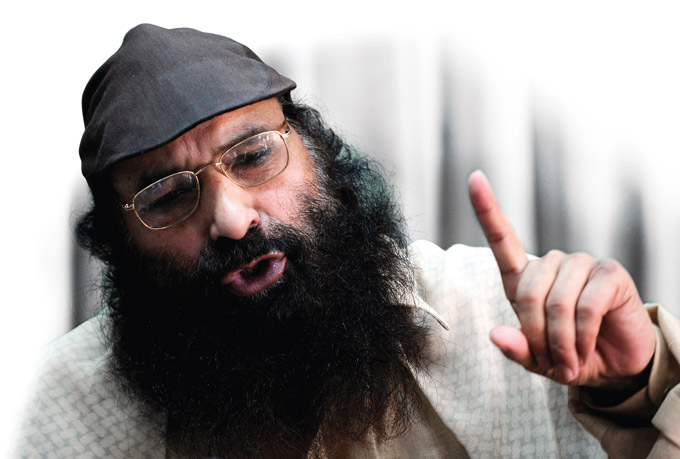
EXCERPTS FROM AN INTERVIEW
You have expressed willingness to talk to New Delhi provided it proposes a “sincere offer on Kashmir”. What kind of offer are you expecting?
The motive behind holding dialogue is to end the decades-long dispute. If India comes up with a sincere offer, we are ready to respond positively. India and Pakistan have met more than 150 times to talk about Kashmir, but there was no success. The reason: Kashmiri leadership wasn’t involved in the talks. India and Pakistan must understand that it isn’t a border issue; neither is it India’s internal affair. Kashmir is subject to more than a dozen UN resolutions. We have two-thirds of Kashmir under Pakistan’s administration that we call Azad Kashmir. All this makes Kashmir a fit case for trilateral talks. The offer will succeed only if India shuns its stubbornness and accepts Kashmir as a dispute, releases all political prisoners, removes troops and withdraws all draconian laws.
The motive behind holding dialogue is to end the decades-long dispute. If India comes up with a sincere offer, we are ready to respond positively. India and Pakistan have met more than 150 times to talk about Kashmir, but there was no success. The reason: Kashmiri leadership wasn’t involved in the talks. India and Pakistan must understand that it isn’t a border issue; neither is it India’s internal affair. Kashmir is subject to more than a dozen UN resolutions. We have two-thirds of Kashmir under Pakistan’s administration that we call Azad Kashmir. All this makes Kashmir a fit case for trilateral talks. The offer will succeed only if India shuns its stubbornness and accepts Kashmir as a dispute, releases all political prisoners, removes troops and withdraws all draconian laws.
Are you happy with the lawmakers’ visit and the role of interlocutors?
Not at all. It was a ploy to hoodwink the international community. India wanted to end the people’s movement and buy time. But what New Delhi forgets is Kashmiris won’t compromise on their stand.
Not at all. It was a ploy to hoodwink the international community. India wanted to end the people’s movement and buy time. But what New Delhi forgets is Kashmiris won’t compromise on their stand.
New Delhi may have second thoughts about your intention in light of past experiences with the UJC, which had called off its unilateral ceasefire in 2000.
It was senior Hizb leader Majid Dar who announced the ceasefire without taking the UJC central command into confidence. Because Dar went ahead with it, the UJC offered him support. However, India didn’t respond appropriately until the deadline passed. Delhi was to blame, not the UJC.
It was senior Hizb leader Majid Dar who announced the ceasefire without taking the UJC central command into confidence. Because Dar went ahead with it, the UJC offered him support. However, India didn’t respond appropriately until the deadline passed. Delhi was to blame, not the UJC.
Dialogue has always been linked with militancy. New Delhi wants Pakistan to crack down on training camps across the LOC and UJC cadres to drop guns before coming on the table. Will that happen?
Not really. I am for talks but we will never drop our guns first. Talks and fighting can go on simultaneously. And why would Pakistan crackdown on militants? We aren’t fighting from Pakistan’s territory. We are fighting from the liberated portion of Kashmir. We don’t consider both sides of Kashmir as different regions. We will continue to cross this bloody line (LOC) at any time.
Not really. I am for talks but we will never drop our guns first. Talks and fighting can go on simultaneously. And why would Pakistan crackdown on militants? We aren’t fighting from Pakistan’s territory. We are fighting from the liberated portion of Kashmir. We don’t consider both sides of Kashmir as different regions. We will continue to cross this bloody line (LOC) at any time.
So you will continue fighting the troops?
Yes. India has never been sincere in talks. New Delhi only understands the language of armed resistance. It’s the only bargaining tool left with the mujahideen.
Yes. India has never been sincere in talks. New Delhi only understands the language of armed resistance. It’s the only bargaining tool left with the mujahideen.
The police claim that not more than 500 militants are left in the state. Does it suggest fatigue among the UJC cadres?
If we are only 500 in the state then what are 8 lakh troops doing there. Such a big presence suggests that fatigue is not ours. In fact, New Delhi is sending more troops to Kashmir, which means they are suffering more casualties than we are.
If we are only 500 in the state then what are 8 lakh troops doing there. Such a big presence suggests that fatigue is not ours. In fact, New Delhi is sending more troops to Kashmir, which means they are suffering more casualties than we are.
You said that last year’s agitation was diluted by fractured leadership and frequent strike calls by Hurriyat leaders.
I didn’t say dilute. What I said was that it was the people’s movement that needs constant pace. Almost 50 percent of the Valley’s inhabitants live a hand-to-mouth existence. Continuous strikes don’t help them. However, my statement was wrongly interpreted.
I didn’t say dilute. What I said was that it was the people’s movement that needs constant pace. Almost 50 percent of the Valley’s inhabitants live a hand-to-mouth existence. Continuous strikes don’t help them. However, my statement was wrongly interpreted.
‘I have found that the stonepelters are bigger contributors to the Kashmir cause than me’
There seems to be an inconsistency between what you and Syed Ali Shah Geelani tell the youth. He has urged them not to pick up guns saying, “it will make things easy for India”, while you stress on armed resistance.
There is a difference in context and interpretation. What Geelani was speaking about was last year’s agitation. He didn’t want it to die down or get a tag of terrorist-or Pakistan-funded movement. Otherwise, he understands the importance of the armed struggle. We have seen in the past that no military occupation has been ended without guns. However, I have found that stone-pelters are bigger contributors of the movement than me.
Pakistan denies providing weapons. So, where do you get the guns from?
We have become self-reliant on many fronts. Not only can we manufacture bombs and explosives but we can procure weapons from markets in India. In Kashmir, we can buy weapons from troops.
We have become self-reliant on many fronts. Not only can we manufacture bombs and explosives but we can procure weapons from markets in India. In Kashmir, we can buy weapons from troops.
Are Maoists supplying you weapons as was recently hinted by the government?
There is no truth in it. We have been buying weapons from all over the world. We don’t have a direct liaison with the Maoists.
There is no truth in it. We have been buying weapons from all over the world. We don’t have a direct liaison with the Maoists.
Omar Abdullah recently said the youth who have crossed the LOC can come back and live a normal life under the militant rehabilitation policy. Are you for it?
The occupation and violence forced people to cross the LOC. No one is interested in returning until the occupation ends. Omar’s assertion that 600 families have applied for the policy is a big lie. Only three families have applied so far.
The occupation and violence forced people to cross the LOC. No one is interested in returning until the occupation ends. Omar’s assertion that 600 families have applied for the policy is a big lie. Only three families have applied so far.
Pakistan is a key ally in the US-led ‘war on terror’. After 9/11 and 26/11, don’t you think it has become difficult for militants to continue their fighting and there has been a separation between the Kashmiri militants and Pakistan?
On 5 February, people across Pakistan observed Kashmir Solidarity Day. Everyone prayed for Kashmir’s freedom from India. How can Pakistan separate itself from Kashmir when it is committed to the cause more than any other nation?
On 5 February, people across Pakistan observed Kashmir Solidarity Day. Everyone prayed for Kashmir’s freedom from India. How can Pakistan separate itself from Kashmir when it is committed to the cause more than any other nation?
Some observers believe that Kashmir has given up its pro-Pakistan stand. People no longer raise pro-Pakistan slogans and a majority want azadi.
The UJC is all for merger with Pakistan. I firmly believe that it is in the interest of the subcontinent that Kashmir goes to Pakistan. I feel that a majority of the people support this stand. However, if people are given the right to self-determination in which they opt for independence, India or Pakistan, we will back them. The UJC will endorse the people’s decision. But it is equally true that Kashmiris in all the agitations of the past four years have raised pro-Pakistan slogans.
Do you see a solution in the near future?
We are optimistic. Maybe in a year or five years, the issue will be resolved according to the people’s wishes. India can’t hold Kashmiris under the gun for long.
We are optimistic. Maybe in a year or five years, the issue will be resolved according to the people’s wishes. India can’t hold Kashmiris under the gun for long.
(Published in Tehelka Magazine, Volume 8 Issue 13, Dated April 2, 2011)
http://www.tehelka.com/we-arent-fighting-from-pakistan-we-are-fighting-from-liberated-kashmir/